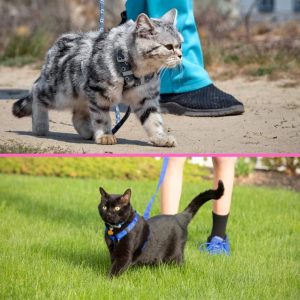
Although, sometimes, domestic cats do walk behind their owners for a relatively short distance (a behaviour characteristic that I explain below), in general, it is fundamentally alien to domestic cats to walk with their owner on a lead like a dog on those nice country walks in the park. If you could talk to …
This table comes from the sciencemag.com website. I feel the need to reproduce it verbatim in the interests of accuracy. It is a way of testing social intelligence in cats. It has been found that domestic cats are more socially intelligent than once was thought, but sadly they cling to their reputation as social …
The social cat species are: the lion, the cheetah and the domestic cat including free-living cats. Scientists had thought that lions and cheetahs were the only social cat species but you have to add domestic cats to that select group. Everybody knows about the lion pride. The cheetah is considered a social animal to …
There is quite a lot of discussion on the Internet about whether domestic cats are or are not sociable. The debate is valid because the wildcat ancestor of the domestic, the Near Eastern wildcat, is not sociable. We are told that they are solitary creatures. However, you will find that the experts agree that …
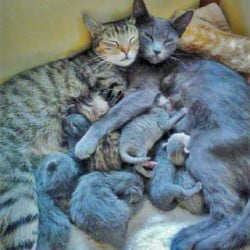
It is wrong to say that only lions live in groups because feral and stray cats live in colonies. And domestic cats in households often live in small groups too. Both the lion and the domestic cat are different species of cat (Panthera leo and Felis silvestris catus respectively). You might find that the …
This article is about understanding feral cat behaviour in colonies. Perhaps the first important point to note about feral cat colony behaviour is that historically the popular press still tends to describe the domestic and feral cat as an asocial, solitary species with no need for companionship and a preference for living alone. This …
Why do some cats love dogs but hate other cats? Essentially, the answer is to do with the territorial nature of the domestic cat inherited as it is from it’s wild ancestor. Despite domestic cats being far more sociable nowadays, after about 10,000 years of domestication, they are still essentially independent minded, solitary and …
Contrary to what is historically portrayed, the domestic cat is not asocial. In fact the domestic cat is a decidedly social creature or at least is able to be sociable. This is due to the evolution of the domestic cat over 10,000 years. One day perhaps in another 10,000 years the domestic cat will …
Note: Some older videos on this page were hosted on Vimeo. That account has now been retired, so a few video blocks may appear blank. Thanks for understanding — there’s still plenty of cat content to enjoy!