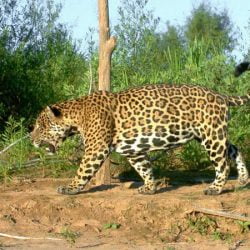
We are told that, in the wild, jaguars live between 12-15 years. Although Mel and Fiona Sunquist in their excellent book Wild Cats of the World (2002) state that jaguar “longevity in the wild is unknown”. On my reading about the longevity of wild cats in the wild, 12-15 years is about the average …
Jaguar cubs are cute and beautiful but you don’t expect to see a picture of one in the wild, do you? The jaguar is pretty rare and elusive with an approximate world population of about 8,000 (2022 but see below) and a minimum of about half that (the experts don’t really know the number, …
Where do Jaguars live? is a question quite a lot of people ask and the answer is a little surprising because we are used to the big wild cats living in Africa (leopard, lion, cheetah) and Asia (tiger, leopard). Jaguar – photo by Property#1 (Very Busy) (new window) RELATED: Are jaguars…13 questions answered about …
The jaguarete is better spelled with an accent acute over the last ‘e’ like this: jaguareté. This means it should be pronounced: jaguareteh as in saying ‘eh you’ or ‘Eh? What’s this?’. I don’t believe that it should be capitalised because it is not a proper noun. Although early naturalists referred to the jaguarete …
Jaguars can be seen in a range of tropical and subtropical habitats. They can live at sea level to about 1,200 m above sea level. There are records of jaguars living at 3,800 m above sea level in Costa Rica and at 2,700 m in Bolivia while in Peru jaguar tracks have been seen …
This is a great picture from a short video made by The Big Cat Sanctuary showing Neron, a male, melanistic jaguar. The spots are called rosettes and they are nicely visible. It shows that black jaguars, a.k.a. “black panthers” are not completely jet black. They often retain ghost markings but the markings on Neron …
Jaguars communicate primarily through the sounds that they make (vocalisations) and in addition through: urine spraying, scrapes i.e. claw marks on the ground and objects, and depositing their faeces in prominent locations. They use these communications to indicate their occupancy of their home ranges which is the territory that they occupy, which they call …
The jaguar seems to prefer peccaries (javelina or skunk pig) although their diet reflects the abundance of whatever prey animal is available. There have been a number of studies which indicate that jaguars “have a particular fondness for peccaries” (the words of Fiona Sunquist in Wildcats of the World page 309). She is referring …
Note: Some older videos on this page were hosted on Vimeo. That account has now been retired, so a few video blocks may appear blank. Thanks for understanding — there’s still plenty of cat content to enjoy!