The infographic explains! 😻 No need to add a lot of extra words. This is a quick read which is what internet users like nowadays. When a cat does this their tail might twitch a little to indicate a little uncertainty. They are in a vulnerable position thanks to their trust in their caregiver. …
Your cat might roll over on their back, belly up when they see you but I am not sure that it is very commonplace. It happens but less often than the classic cat greeting which is to come up to you and rub their flank against your leg and hop up to head butt …
Introduction: This article on the social function of tail up in domestic cats is based a scientific research paper of very similar title prepared by S.Cafazzo and E.Natoli. and which was published on the internet by Science Direct. The right to read the entire document was purchased by me. It is a summarized version …
Why do domestic cats carry out ‘scent exchange’ with their owner? First of all, what is scent exchange? It may not be apparent to a cat caregiver that it is taking place. However, it happens very often, particularly when a cat owner comes home and their cat greets them. The cat will do one …
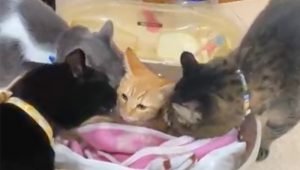
This seems to be some sort of shelter where there are many cats. She may be a foster carer operating from home. Three of her resident cats check the credentials of the incoming newbie with great interest and intensity. The newbie accepts it all but plaintively cries out as he is unsure about what …
There are advantages to presenting the back of your hand when greeting a domestic cat, including your own cat. I always do it. This may be because my cat is a former feral cat and is perhaps a little twitchier than your average domestic cat. However, I have found that if I inadvertently wave …
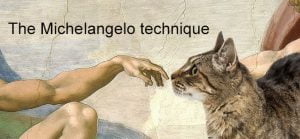
The Michelangelo technique for humans greeting cats is Jackson Galaxy’s. I’d rather use his inimitable words than mine as I don’t want to in any way misdescribe it. As the cat approaches, I will allow my hand to relax, palm down, extend my pointed finger – not extended rigid, but relaxed, so that it …
Conclusion My understanding of these two feline terms, ‘butting’ and ‘bunting’ is that the former is a sign of friendship (but does not deposit scent) while the latter is about depositing scent, for scent marking, from scent glands in the cat’s head but this too is a sign of friendship when the scent is …
Note: Some older videos on this page were hosted on Vimeo. That account has now been retired, so a few video blocks may appear blank. Thanks for understanding — there’s still plenty of cat content to enjoy!