In my opinion it is 95+% safe to eat your cat’s leftover human-grade treats but you won’t find a conclusive answer to the question in the title on the Internet because there probably isn’t one. The reason why I ask the question is because about an hour ago I ate the remains of my …
Read more
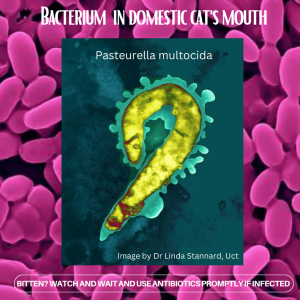
The great bacterial culprit in the mouth of domestic cats is a bacterium called Pasteurella multocida. It is found in the mouths of between 70-90% of domestic cats and perhaps more importantly between 50-80% of people at the site of a cat bite (Cornell). So, this particular bacterium is the major cause of infections …
Read more
There is a perception among some people that stray cats are diseased and can transmit infections to people. I’m reminded of this by a woman in Hong Kong, Icy Song, who runs into stray cats on her way to Lingnan University. She comments as follows: Although I feel pity for the stray cats, I …
Read more
The question in the title makes a presumption that there is more bacteria in the mouths of cats than in the mouths of people. That might not be true.
I would bet that almost nobody washes their hands or face after their cat licks them. I don’t. But a science journalist, Erika Engelhaupt, writing for National Geographic recommends it because of the hundreds of different species of bacteria in the mouths of cats and dogs which are alien to humans. One bacteria species, …
Read more
A cat, the family’s pet, licked a three-week old baby’s bottle and the baby ended up fighting for her life in hospital with meningitis. The bacteria that caused it resided in the mouth of the cat and is called Pasteurella multocida3. However, it must be made extremely clear that it is very, very rare …
Read more
Note: Some older videos on this page were hosted on Vimeo. That account has now been retired, so a few video blocks may appear blank. Thanks for understanding — there’s still plenty of cat content to enjoy!