
For many years, I and others, have referred to research and a nice archaeological photograph from the island of Cyprus (see below) which established – it was thought -that the North African wildcat was first domesticated about 9,500 years ago.
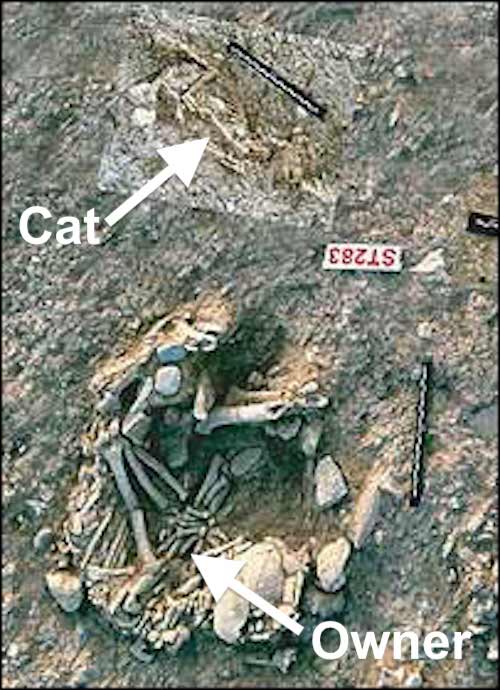
New research referred to in a Times article (‘Tiddles turned up 4,000 years later than we thought’) claims that domestic cats have been present about 6,000 year ago in North Africa but these were domesticated wildcats. So what? All domestic cats today are at root domesticated wildcats!
The new research states that ‘the first domestic cats who share genetic traits with modern pet felines appear about 2,000 years ago’.
For me the research is muddled (as reported – perhaps the report is muddled!?).
It is all about the degree of domestication. A farmer making friends with a wildcat, feeding him and the wildcat reciprocating with affection (albeit wildcat-style affection) is as valid a case of cat domestication as found in today’s homes I would argue.
It seems to me that what the new research is saying that the evolution of the domestic cat as shown up in genetic traits took hold 2000 years ago. Perhaps we might argue that these were the first ‘true’ domestic cats and not domesticated wildcats.
But there is little true difference. Modern well-behaved domestic cats are a whisker away from their wildcat ancestor in terms of behaviour.
They often revert to their wildcat character if allowed out under an indoor/outdoor cat regime.
Cat owners see the wildcat with their domestic cat all the time unless it has been knocked out of them by being full-time indoor cats with no ‘catification’ of the interior through which they can express their natural instincts.
I raised my cat as a feral kitten. Even today at 11 years of age he visibly, through behaviour, retains those wildcat instincts. He even looks like a North African wildcat 😉. See him here:

[Neutering feminises the male cat I would argue. Makes them look sweeter and less male and wild]
The biggest cause of friction between owner and cat is the simple fact that domestic cat behaviour is very similar to wildcat behaviour. Often cat caregivers don’t like it. They desire fluffy, compliant companions almost like a living plush toy! They hate their cat bringing in dead and dying mice.
Afraid not – cats are living sentient beings with feline, wild instincts. So to reiterate, the research discussed in The Times is about finding the cut off line when ‘true’ domestication of the wildcat took place. Fair enough, but we can’t sensibly claim that a thoroughly domesticated North African wildcat is not a domestic cat. On that basis domestic cats existed about 10,000 years ago.
Even today there are many instances of African wildcats willingly becoming domesticated in villages in Africa. It is happening all the time.
I’d call these domestic cats.
