
It is increasingly recognised by researchers, monitoring organisations, and policy analysts that decisions made by the Israeli government during the Gaza conflict were a cause of the rise in antisemitic incidents in the UK. This does not imply intent, nor does it assign moral blame to any political leader. Instead, it reflects a clear causal sequence: military actions in Gaza generated global reactions, and those reactions created conditions in which antisemitism increased.
It is a great shame that the decision of Netanyahu to destroy Gaza has led to a rise in antisemitism. Perhaps an unforeseen consequence. But it has got so bad in the UK that Sir Mark Rowley placed the UK on a ‘severe’ terror threat stance after two Jews were subject to an attempt to murder them by stabbing. The alleged perpetrator is a British national of Somali origin who suffered from mental health issues and a violent past as I understand it.
My thoughts are that the threat level has been raised for political reasons; to send a clear signal to the Jewish community that the UK government is taking seriously the protection of Jews in the UK. They have called for it. Many Jews are anxious. Some openly frightened about the current state of affairs.
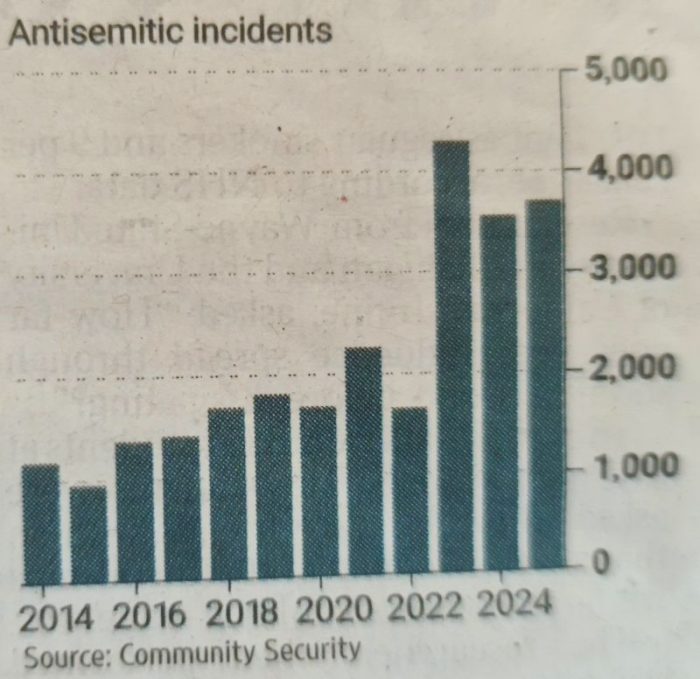
The military campaign authorised under Netanyahu’s government was aimed at destroying Hamas following the 7 October attacks. However, the scale of destruction in Gaza, the high civilian casualty figures, and the intensity of global media coverage produced a powerful international response.
The killing of Palestinian babies in large numbers is constant chant by protestors on the streets of London. The best available estimates indicate at least 1,000 babies (infants under one year old) have been killed, with the true number likely higher because many bodies remain unidentified or unrecovered
Public opinion shifted sharply in many countries, including the UK, where anger at Israel’s actions became widespread. Monitoring bodies such as the Community Security Trust (CST) documented how a portion of this anger was misdirected at Jewish communities, despite their complete lack of involvement in Israeli policy.
This misdirection is a well‑established sociological mechanism: when a state engages in a highly visible conflict, diaspora communities often become symbolic stand‑ins for that state, regardless of their actual views or connections. In the UK, this dynamic contributed to a surge in antisemitic incidents, particularly around protests, universities, and online spaces. The CST’s data shows that these spikes closely tracked periods of intense Gaza‑related news coverage.
Thus, decisions made by Netanyahu’s government were a cause of the environment in which antisemitism rose, even though the responsibility for antisemitic acts lies solely with the individuals who committed them. The injustice is clear: ordinary Jews in the UK—who do not vote in Israeli elections and have no influence over Israeli military decisions—experienced the consequences of a conflict thousands of miles away.
