
Can FIV positive cats live with other cats? The answer has to be a qualified yes. It is safe for FIV positive cats to live with other cats by which I mean cats not carrying any diseases. Although, it cannot be said to be 100% safe at all times, it can be said to be 99% safe dependent upon cat management. I hope that I have been fair in making that assessment (wrong? – please tell me). There has been some confusion or some uncertainty about the safety of putting non-FIV positive cats with FIV positive cats in the same environment be it a cat shelter or a multi-cat household.
The classic veterinary response with respect to transmission of the feline immunodeficiency virus (FIV) is that it occurs when a FIV positive cat bites a non-FIV positive cat and it may be passed if a queen becomes infected while pregnant and passes the virus to her unborn kittens. In fact the well-known Drs Carlson’s and Giffin’s Cat Owner’s Home Veterinary Handbook has stated in one edition that FIV positive cats should be isolated from other cats. This information would seem, now, to be out of date.
Important research carried out by Anette Litster on cats at two rescue centres found that there was no transmission of the virus between FIV positive cats and non-FIV positive cats, both horizontally or vertically.
By “horizontally” it is meant between different cats and by “vertically” it is meant between infected mother and her unborn kittens.
In one cat rescue centre there were 138 cohabiting cats of which eight were FIV positive (six male neutered and two female spayed). After several tests over years of exposure between the cats there was no evidence of any transmission of the virus.
In another rescue centre records indicated that from five FIV positive queens with 19 kittens all 19 kittens tested FIV negative which suggests that vertical transmission had not occurred.
Obviously, this study does not categorically state that transmission will never occur between cats and between queen and unborn kittens but it strongly suggests that transmission is very difficult for this virus and rarely occurs.
The fact of the matter is that when transmission is through a cat bite (whereupon the saliva which contains the virus is injected into the receiving cat) it has to be said that bites of this type in multi-cat households and in cat rescue centres are obviously very rare and if they can be avoided through proper management then there will be an almost zero possibility of transmission between cats it seems to me.
In the past I have been criticised for failing to spell out the lack of danger from FIV positive cats at shelters. It is important because FIV positive cats are more likely to be euthanised unnecessarily simply because they are FIV positive. This is wrong based on the above research.
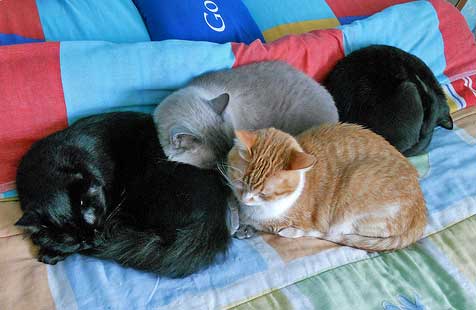
- Photo: Harmonious group – Photo by Bibi
- Lister’s page on PubFacts
- Search results on PoC for ‘fiv’.

Because Shadow only has his canines, he cannot easily eat pate wet food, so I usually go for morsels. That being said, higher-grade wet food examples in the USA would be brands such as Natural Balance and Merrick. Another very good one is from Fromm; it’s made in the USA without the chemicals frequently found in lesser grade foods.
In our house, I buy the packets of Indoor formula of Natural Balance. In the Merrick brand, I buy either morsels or shredded and with Fromm, I buy dry food as they’re very small, round pieces and Shadow can eat them (I also wet the dry so it’s a little softer). Also for dry food, I buy Natural Balance’s Fat Cat. The nuggets are slightly larger than Fromm’s but that particular brand has the lowest caloric value found in today’s market (that I’ve found anyway).
Per vet advice, he admonished that it’s OK to put down dry food; however, stop topping it off. When my brood were on a diet, the vet suggested 1/2 can of 6-oz food each (or split the large can in half for the two of them) and only a few nuggets of dry in a separate dish for the crunch factor. It’s the carbs in the dry food that packs on the weight. He also suggested to close ears to the cats’ crying for more food if they’ve been properly fed according to instruction. He said when they start, distract them with play. It sure has worked! Each have lost about 5-lbs each over a 6-month period, which was significant for them. Now they’ve got their energy back!
Thanks for this Dee. The reference to aggression is the important point I feel. Avoid that and the chance of transmission is reduced to almost zero.
Gail, please tell me your selection of high grade wet cat food in the USA. I agree that high grade wet is very important.
Dee, I imagine Dr. Fleck has also checked Princess’ teeth for gum disease. My understanding is that it is common with FIV+ cats.
My vet also encouraged a higher-grade wet cat food (and dry if given) for our house, not just for Shadow but for Abby as well. He said that, although cats have lived on supermarket grade wet food for years, his opinion is that it’s the “McDonald’s” of cat food. Sure, they love it but that didn’t mean it was particularly good for them long term).
Since switching to a higher-grade food, both of my cats have beautiful coats, appropriate weight and both have wonderful energy (sometimes to my chagrin, LOL).
Wishing you and Princess the very best. The only advice I would give is just to watch her should she get the sniffles; it’s not the same as a negative cat; the immune system is compromised. All things being equal, there is no reason that your fur baby shouldn’t continue to thrive in your loving home.
Thanks, Irish. You are so right.
My beautiful Princess has just been diagnosed with FIV.
I was crushed.
But, FIV isn’t necessarily a death sentence.
She is almost 5 years old and has suffered from URI’s on and off for her whole life.
The new vet that I had just kept popping antibiotics that only took the edge off of her distress.
No one thought to test her.
Out of desperation, and because she had stopped eating, had become skin/bone, and I could see the glands on the side of her neck and under her chin enlarged, I asked our TNR vet to look at her. Dr. Fleck is a feline only vet and pretty much knew that she had to be FIV positive.
She was tested and, ofcourse, positive.
How this relates to this article is that Princess has lived in harmony with my house full of cats for almost 5 years. So, isolating her would be moot at this point.
According to my beloved Dr. Fleck, FIV really isn’t very easily transmitted unless there is a lot of aggression going on. Trust me, not allowed here.
At this point, Princess is in remission having been treated with Convenia and an appetite inducer. She’s picking up weight, strength, and her coat has a promising gloss again.