
Ecology + Behavior + Social Organisation
Overview
The tiger is adaptable in terms of habitat and climate. The tiger is very athletic. It can climb well when needed and swim exceptionally well (by human standards) when required (2 miles in sea water – see Lion vs Tiger). What they need is water and large prey (ungulates – hooved animals) to survive. The best prey base in Asia is where there is a mosaic of forest and grassland7. The environment that suites the tiger also suites the leopard and the wild dog (dholes). A pack of wild dogs can kill a tiger7. But it can dispatch a leopard at will. The leopard steers clear of the tiger, accordingly, despite sharing the habitat with it. Where there is a reasonable tiger population the leopard population is reduced. In Siberia it is outgunned by the bear.
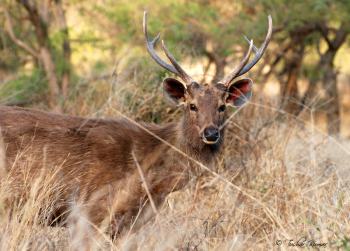
Sambar deer
The scope of the tiger’s adaptability is evidenced in the width of the range. The Siberian tiger lives in an environment of coniferous and birch woods where there is snow and where temperatures fall to minus 30°C to minus 40°C. Snow can be a problem for a tiger both in terms of camouflage and stalking. Tigers avoid deep snow and icy snow can cut them. This is in contrast to the hot forests of Sumatra, where the Sumatran tiger lives. In Sumatra the tiger lives in ancient tropical lowland evergreen forest that is being cut down. It is also noisy making stalking difficult. Further south the Bengal tiger has adapted to living in swamps and sea water (Sundarbans, Bangladesh).
One predator that the tiger avoids is the human, which means it has become nocturnal. Given a free choice the tiger would hunt day or night and kill any animal that is vulnerable to it. Often hunting means travelling great distances by human standards. For example, males not uncommonly travel 30 kms per night in search of food. The search for food starts at sunset. Tiger have well worn routines (don’t domestic cats too) and will travel along the same routes to known hunting sites. A failure to catch prey means moving on as the tiger’s presence is often by then well advertised by the alarm calls of the deer.
Prey
As mentioned tigers are adaptable and although there are favorite prey species they will eat almost anything up to an elephant. But other top predators are not commonly attacked as prey for obvious reasons. Deer and wild pigs are the most common prey. The type of deer depends on the region. Typical deer species would be Sambar and Chittal (see photo). This preference for pigs and deer extends from India (Bengal tiger) to Russia (Siberian tiger – in Russia up 84% of all tiger kills are pigs or red deer7). In the south, say in Thailand the prey is smaller such as barking deer. The tiger does not select weak and/or old prey. Prey that is substantially larger than the tiger is also killed, e.g. water buffalo and gaur. In timespast people, for entertainment, thrust buffalo and tiger together in a cage. The buffalo always won. So this is dangerous prey. Tigers are killed by buffalo and bison.

Hello my loved one! I wish to say that this post is amazing, nice written and include almost all important infos. I would like to peer extra posts like this .
Is the Siberian population increasing? Please tell me more. I had thought it was stable at around 400 with an effective breeding population of about 14! This is due to inbreeding.
Love the tiger it’s my favorite animal, I am glad the numbers of Siberian Tigers in the wild are increasing.