
The RSPCA and Catch Protection, the two most respected rescue organizations in the UK are urging the government to make it compulsory for cat owners to microchip their cats. Compulsory microchipping is being introduced for dogs in April 2016. They say it should also apply to the 10.5m cats in the country.
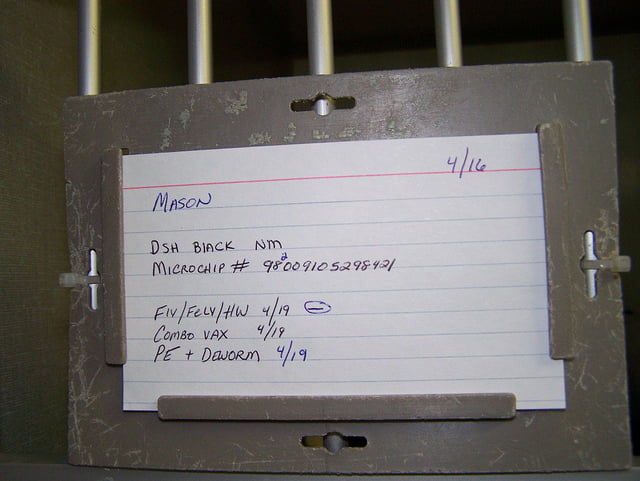
I know we are going over old ground but this is the first time that these two large rescue organizations have made a direct plea to the government to do what a lot of people consider to be common sense.
We know that micro-chipping helps reunite lost cats with their owners. That is the purpose of it and it works. It also encourages more responsible cat guardianship.
Cats Protection said that cat caretakers should be fined for failing to comply after receiving a warning. Dog owners will face a fine of up to £500 if they fail to comply with a notice which requires them to have their pet microchipped within 21 days.
Cats Protection said that it had to plant microchips in a 83% of unwanted or lost cats that it had re-homed. This obviously signifies that the vast majority of cats are not microchipped. The cost to the organization for microchipping cats that it rehomed is £900,000 a year.
The cost of microchipping is relatively low at £20-£30. Failing to microchip cats which have been lost and picked up by Cats Protection often means that the organization has to rehome them needlessly.
“When we take an unchipped cat into our care it can be very difficult to trace the owner and may well result in us re-homing a cat needlessly.”
Jacqui Cuff, the charity’s advocacy manager, referred to another benefit of cat microchipping. She said that compulsory microchipping will also help to regulate commercial cat breeding.
Cat Protection would like a fine for non-compliance with any law making it compulsory to microchip. That said they would like time to be given to the owner for her/him to get the cat microchipped and if she complied there would be no penalty.
In Britain about a quarter of households own at least one cat. In Spain and Belgium micro-chipping of cats is compulsory.
Despite the good sense of micro-chipping, the Department of Environment, Food and Rural Affairs said:
“We support micro-chipping as it can help reunite lost pets with their owners. We do not consider this should be made compulsory as cats do not present the same challenges as dogs if they stray.”
I find the government’s answer rather strange and poor. The answer is what I’d call human-centric. In other words they are thinking about the consequences to people when a companion animal strays. Dogs are more dangerous than cats and can seriously hurt people. Therefore micro-chipping dogs means that the owner can be apprehended if their dog attacks somebody. As it happens stray cats can also seriously harm people so the government’s argument from the human perspective does not stand up really.
However, if one looks at a law which makes microchipping compulsory from the perspective of the animal, it clearly makes sense to microchip cats. This is because the cat can be returned to their owner and an environment that they are familiar with. On many occasions it will also result in the cat not being euthanized because of the failure to find a fresh home. I realise that some cats in some homes are better off being rehomed.
The West (let’s say Europe and the UK) and the Australian continent are heading towards compulsory microchipping in my opinion. The only question is when. Personally I have always advocated an approach to cat ownership which is less laissez-faire than is currently in place in order to raise the bar in respect of cat ownership caretaking standards.

I personally don’t see any downside to micro-chipping other than sometimes they can cause health problems. There is a problem there potentially but it is quite a slight problem. Other than that micro-chipping puts some sort of structure and order into cat ownership in the UK which I think is beneficial all round. At the moment it is completely without regulation. There’s nothing in the way of regulation governing owning and looking after a cat. I don’t think that is quite good enough.
Yes, micro-chipping is a bit Orwellian but it is a compromise. Life in the West is somewhat Orwellian already as we are being watched on our computers and telephone calls or instant messages. Our twitter accounts are being scanned by Big Brother and so on and so forth. Is the nature of what we have created. In a way the fact that micro-chipping is arguably beneficial to the domestic cat indicates to a certain extent that our relationship with the domestic cat is not that great when you look at it globally.
I think, perhaps, you are being a little bit too negative about it. There is an automatic deterrent quality about the criminal law. If people realise that they might be penalised for not complying with the law then a certain percentage of irresponsible people will be forced to be responsible.
I agree that policing it may be difficult but I suspect that the veterinarians would be involved here to a certain extent. At some stage even cat owners who some might consider irresponsible will probably take their cat to the vet. At that point they can be checked out for micro-chipping. Of course, if the cat is not micro-chipped the person may not take their cat to the vet. In which case the law would work against the health of cats.
I consider obligatory micro-chipping a little bit like making wearing seat belts compulsory. It is very hard to enforce the law in respect of seat belts but over time everybody puts them on even though the vast majority of people have never been stopped. It is the fear of being stopped and fined which is the deterrent.
Over time people then become habituated to micro-chipping their cat and it no longer needs policing and enforcing. That’s the way I see it working.
If people plead poverty then they would be lying because at £20-£30 a time for neutering even the poorest person on benefits can afford it and if they can’t they shouldn’t have a cat so the cat could be rehomed.
The bottom line is that the law can create a new culture over time and I think that will happen with respect to compulsory micro-chipping.
I agree with you Dee, compulsory microchipping would be easier to enforce in areas where cats don’t have a legal right to roam.
It could however put vets in an awkward position if they are expected to participate in policing whether pets have been microchipped or not. Will they be legally obliged to report such owners to the authorities if they refuse to allow the vet to microchip their animal?
Replied to myself intentionally so I could add to my comment.
I feel so sorry for those who keep indoor cats and one just bolts out. They’re doomed to be killed.