
We know that Australians in government are waging a war against the dreaded feral cat in their country because they feel that it is killing too many native wild animals. There have been many proposals on the best way to kill feral cats. They are all inhumane. TNR has never been discussed.
Now they have devised robotic killers which detect feral cats and then spray poison onto the cat’s fur. The poison is licked off by the cat and the cat dies. These devices have been deployed in the desert.
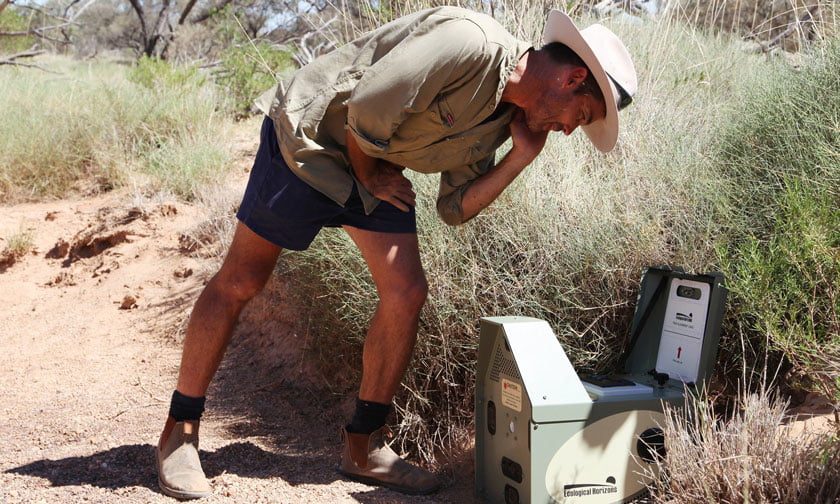
The device has been invented by John Read. He is an ecologist. It took him seven years. He has manufactured four of these devices and the first one is currently in action in a nature reserve in South West Queensland.
He says that “this trap targets the cat’s Achilles heel”. What he is referring to is that all cats are fastidious self-groomers. They’re bound to lick the poison off their fur. His robotic device exploits this “weakness” as he sees it.
The device employs laser range finders. It detects when something moves in front of it. If it detects that the animal is taller than a cat it shuts down. The same response takes place if the animal is “low-slung” such as a wombat. Obviously the intention is to avoid killing native species!
Two rangefinders at the front and back of the device have to be triggered simultaneously for the device to spray poison on the animal in front of it, which should be a feral cat if the device is functioning properly. What about domestic cats who are wondering outside?
Custom search results for killing feral cats in Australia on PoC
John has clearly given a lot of thought about how to avoid killing native species which would be the exact opposite to his intentions. Another way to ensure that the device kills cats is that the poison being used is called “1080”. This occurs naturally in some plants. The idea is that native animals are less susceptible to it — i.e. to being killed by it. The dosage used is able to kill three cats but unlikely to kill a native animal, John says. I am not sure that his thinking is logical. Is it logical to state that just because an animal is native to a country it is less susceptible to a poison simply because it happens to be contained within some plants which are also native to the country? I’m not sure about that.
Another argument that John makes is that most animals other than cats are less likely to lick their fur as cats do and therefore are less liable to ingest the poison.
In addition, this poison producing device emits sounds similar to those of the prey of feral cats which hopefully will attract the cats to the device.
There are, in fact, three trial locations. Based on the trials the devices will be optimised with the intention of manufacturing 50 or more for further and more extensive trials over a wider range in the future.
Up until now just under AU$500,000 has been spent developing the traps. Part of the funding comes from the South Australian government.
It is hoped that the devices will help protect parrots at the Pullen Pullen Reserve.
What you think about this? Australian scientists are certainly exercising their brain matter to devise ways to exterminate the feral cat in Australia. This device is one in a long list of proposed methods. Poisoning seems to be coming to the fore as the most effective means of achieving their aims. The great weakness with poisoning is that you might poison animals other than feral cats. The fact that the death is inhumane and cruel and that Australians created the feral cat appears to be irrelevant to their thinking. Oh…and they also ignore the simple fact that humans kill far more wildlife than cats through habitat destruction. Hypocrites.

Greg, TNR done properly and extensively does work. There are many examples in the USA. Poisoning like this is less effectively and I believe that you’ll find that out at the end of the day.
Totally agree with you Catherine. What they are doing does indeed stain their country. Anyway it won’t work. It is horribly cruel.
Thanks Ali. I am pleased that you disagree with what is happening. It pleases me to know that.
Thanks for commenting Steve. Strong words.
Good fuck off, we don’t want retards like you in the country anyway.
I doubt children will be at risk, these traps are in the outback. For all you Americans, these are not your normal domestic cat, they are not cuddly nor are they friendly. They cause un told damage to our native wildlife bringing a lot of species to near extinction. They can not be tamed and they can not be let go back into the wild because of the damage they do. I agree that this may not be the best solution, however, it would be that or shooting them or trapping and euthanasing them. Humans are the cause, irresponsible owners who let their cats roam and breed in the wild. Bur non the less, a huge problem they are as are rabbits, foxes and wild pigs..