
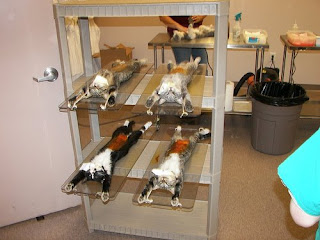
One in 416 cats die under anesthetic. Cat owners should know the chance of their cat dying under general anesthetic. A lot of medical procedures on the domestic cat require a general anesthetic. Even simple ones such as cleaning a cat’s teeth require a general anesthetic unless, of course, you have trained your cat to accept teeth cleaning while alert and awake.
Some people are so keen to give their cat a lion cut that they accept the risk of putting a cat under general anesthetic so a vet can do it. Although some vets don’t do lion cuts with the cat under general anesthetic – thankfully.
I have heard of a 1% chance (1 in 100) of a cat dying under anesthetic. I heard that figure in a vet’s clinic in London, UK while I was chatting to a cat owner who was nervous about his cat’s teeth being cleaned.
I have also heard of .1% chance (1 in 1000). These are both significant numbers and I think they affect our decision making. Yesterday, I found the results of a full blown study on the risk factors for anesthetic related death in cats. It took place in the UK between 2002 and 2004. That is 8 years ago so the standards may have improved since.
The study was pretty comprehensive in that 79,178 operations (“anaesthetic and sedation procedures”) were recorded from 117 veterinary clinics. I would have thought the data was accurate which is what I was looking for because as usual on the internet figures are bandied around and you can get misinformation quite easily.
The study concluded that 0.24% of cats died under anesthetic (“anaesthetic and sedation-related death”). 0.24% is 1 cat in 416 cats. So every 416 operations that require an anesthetic the cat dies as a result of the anesthetic.
I would trust these figures. On that basis, it does give a cat owner something to base their decision making on. A lot of operations on cats are necessary. There is no choice so the slight risk of dying under anesthetic has to be taken. Of course the cat himself has no choice in the matter. An interesting thought is “would the cat make the same decision as a human?”
But in other operations or procedures there are choices and the vet would probably ask you whether he should proceed or not. You need all the information you can get to make the right decision and a major influencing factor is the risk of injury or death by the anesthetic.
There must be a variation on the risk between different veterinarians. How up to date and professional are they? Modern techniques and equipment probably reduce risk. The study, incidentally, also concluded that the odds of anesthetic related death were increased by factors such as:
- the cat’s health. A cat in poor health has a higher risk. That is common sense.
- the cat’s age. Older cats have a higher risk.
- very fat or very thin cats (“extremes of weight”) are at a higher risk.
- the complexity of the operation is a factor too. The more complicated the more risk of a cat dying under anesthetic would seem to be conclusion.
- if the operation is urgent there would seem to be a higher risk too.
- “endotracheal intubation” (passing a tube down to the lungs via the mouth and windpipe) is associated with increased risk.
- “fluid therapy” (adding fluids to the cat) is also linked to increased risk.
Two factors are linked to reduced risk:
- pulse monitoring.
- pulse oximetry – I think this is a method to measure and monitor the levels of oxygen carried by hemoglobin in the blood.
How much a veterinarian invests in equipment and keeps pace with new technology is a factor in reducing the risk of injury and death of a cat under anesthetic.
As an interesting comparison, it appears that the risk of death for people is 11-16 deaths per 100,000 persons. That is about 1 in 7700 operations. This figure is much better than for cats. Cats are 18 times more likely to die under anesthetic. Why? Is it because cats are delicate creatures? Or is it because vets are less careful than doctors? Or perhaps it is because the equipment for vets is less sophisticated than for people. Do you know the answer?
The figures for human deaths come from the anesthesiaweb.org website.

Nice thought. I have this gut feeling that cats at vets are not treated quite as carefully as humans at hospitals. That might be laughable because it is so obvious. The underlying culture and opinion has an effect on our behavior but it is almost invisible. Perhaps the underlying reason why more cats die under anesthetic is because we don’t care as much.
Yes completely agree with you on those topics. I think people are more and more dependent on pills. People see answers in pills where they don’t actually exist. In the old days my dentist didn’t even use anesthetic – at all (1960s). And yes, I think you have made a good point as to why cats are more prone to dying under anesthetic. They are smaller and the dosage has to be more precise. For that reason perhaps vets are not precise enough. And if they are less precise than doctors perhaps it is because animals are seen as less important than humans.
Hi Rudolph. Hope you are well and your adorable cats. Maybe someday I’ll come and visit. I have been to India you know back in 1971. Hot! Wet! Loved the place.
Thanks.Extremely informative article and discussions. I am learning.
Maybe cats die during operations because of a combination of the drugs used to put them under and the position they are placed in during surgery. I just looked at that picture of all those cats put under and ready to be spayed. Cats don’t lie in that position naturally, or if they do it isn’t for very long. Maybe it’s hard for them to breath in that position or their breath is more shallow. I would never position a patient with COPD flat on his back. Most people with breathing problems can’t tolerate that position. For humans, leaning forward when short of breath can actually increase oxygen perfusion. I read a study that showed that the prone position increased O2 Sats for every patient placed in that position, which goes against contrary wisdom, because it’s thought being prone would make it harder for the diaphragm to work effectively. But the point is that a positional change alone improved O2 perfusion. Patients weren’t instructed to try to breathe more deeply, and even on their stomachs, which seems to work against taking a deep breath, O2 saturation went up 100% of the time. So if we place a cat in an unnatural position for a cat, for a prolonged period, during which the cat can neither perceive shortness of breath or move to rectify the situation, maybe it does follow that more cats are going to die during operations. It’s just a thought.
You are correct, Michael, pulse oximetry is a way to measure the percentage of blood cells that can carry oxygen that actually are doing so. We use it in physical therapy and try to keep patients at 90% Or above. If anemia is present the pulse ox numbers will be misleading, because even 100% O2 Sats won’t be good enough if there are too few blood red blood cells.
Maybe cats die more often because they are so small and it’s easy to overdose them. The risk is there always for humans, however slight. I need to have a bunch of complex dental work done and I’d love to have then put me under for it, but it’s silly to take that risk if it’s not really necessary. Besides, my husband says the real pain will be later and last a week, so unless I want to be out for days, it really won’t help. I believe this is how the singer, Michael Jackson died. The drugs his MD was giving him as sleep aids were the same as those used in operating rooms. He essentially was being anaesthetised every night. The odds caught up with him. How sad that he took that risk and that a medical professional would have helped him to do it. I think on the whole, in society, we overmedicate ourselves in general. Maybe that’s why some people have no problem putting their cat under for a haircut. They just don’t perceive the risk as being real.