
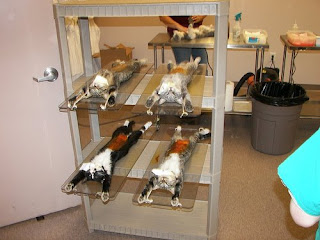
One in 416 cats die under anesthetic. Cat owners should know the chance of their cat dying under general anesthetic. A lot of medical procedures on the domestic cat require a general anesthetic. Even simple ones such as cleaning a cat’s teeth require a general anesthetic unless, of course, you have trained your cat to accept teeth cleaning while alert and awake.
Some people are so keen to give their cat a lion cut that they accept the risk of putting a cat under general anesthetic so a vet can do it. Although some vets don’t do lion cuts with the cat under general anesthetic – thankfully.
I have heard of a 1% chance (1 in 100) of a cat dying under anesthetic. I heard that figure in a vet’s clinic in London, UK while I was chatting to a cat owner who was nervous about his cat’s teeth being cleaned.
I have also heard of .1% chance (1 in 1000). These are both significant numbers and I think they affect our decision making. Yesterday, I found the results of a full blown study on the risk factors for anesthetic related death in cats. It took place in the UK between 2002 and 2004. That is 8 years ago so the standards may have improved since.
The study was pretty comprehensive in that 79,178 operations (“anaesthetic and sedation procedures”) were recorded from 117 veterinary clinics. I would have thought the data was accurate which is what I was looking for because as usual on the internet figures are bandied around and you can get misinformation quite easily.
The study concluded that 0.24% of cats died under anesthetic (“anaesthetic and sedation-related death”). 0.24% is 1 cat in 416 cats. So every 416 operations that require an anesthetic the cat dies as a result of the anesthetic.
I would trust these figures. On that basis, it does give a cat owner something to base their decision making on. A lot of operations on cats are necessary. There is no choice so the slight risk of dying under anesthetic has to be taken. Of course the cat himself has no choice in the matter. An interesting thought is “would the cat make the same decision as a human?”
But in other operations or procedures there are choices and the vet would probably ask you whether he should proceed or not. You need all the information you can get to make the right decision and a major influencing factor is the risk of injury or death by the anesthetic.
There must be a variation on the risk between different veterinarians. How up to date and professional are they? Modern techniques and equipment probably reduce risk. The study, incidentally, also concluded that the odds of anesthetic related death were increased by factors such as:
- the cat’s health. A cat in poor health has a higher risk. That is common sense.
- the cat’s age. Older cats have a higher risk.
- very fat or very thin cats (“extremes of weight”) are at a higher risk.
- the complexity of the operation is a factor too. The more complicated the more risk of a cat dying under anesthetic would seem to be conclusion.
- if the operation is urgent there would seem to be a higher risk too.
- “endotracheal intubation” (passing a tube down to the lungs via the mouth and windpipe) is associated with increased risk.
- “fluid therapy” (adding fluids to the cat) is also linked to increased risk.
Two factors are linked to reduced risk:
- pulse monitoring.
- pulse oximetry – I think this is a method to measure and monitor the levels of oxygen carried by hemoglobin in the blood.
How much a veterinarian invests in equipment and keeps pace with new technology is a factor in reducing the risk of injury and death of a cat under anesthetic.
As an interesting comparison, it appears that the risk of death for people is 11-16 deaths per 100,000 persons. That is about 1 in 7700 operations. This figure is much better than for cats. Cats are 18 times more likely to die under anesthetic. Why? Is it because cats are delicate creatures? Or is it because vets are less careful than doctors? Or perhaps it is because the equipment for vets is less sophisticated than for people. Do you know the answer?
The figures for human deaths come from the anesthesiaweb.org website.

Do not be nervous to get your cat spayed,i was hesitant about my cat being spayed( she is a one year old beautiful Siamese named minka, and is at my side 24/7)and i should not have been, i am regretting it with all of my heart now. She is an indoor cat, and actually has never been outside even for a minute,she ended up going into her first heat cycle,and a few weeks after i noticed that she was acting strange. She was having trouble going to the bathroom, and had a yellow discharge leaking from her vulva, I read about a condition called pyometra,which is basically when the reproductive organs become infected and fill up with pus due to a hormone change during a cats cycle so obviously i panicked because it is VERY serious and life threatening. she seemed a little more lethargic than usual,and as a concerned cat mom i took her to the vet, and he confirmed what i was afraid of. and what is the treatment? an emergency spay to remove the infection which is going to cost me 800+ dollars. she had her surgery this morning and is going to have to stay at the vet for a few days, i am beside myself and heartbroken, because i know this may still cost her life, and it could have been prevented. Moral of the story PLEASE spay your cats, before their first heat cycle , and save the tears and the money.
The vets at both practices I worked for always spayed cats by keyhole surgery on their side, I was taught exactly where to shave the fur and they went in dead centre of the bare patch. The op took only minutes and the stitches needed were few, then the wound painted with gentian violet, no ecollars were needed, cats wouldn’t lick that stuff.
I look back now and realise I worked with some of the best good old fashioned vets, relying on too much technology isn’t always a good thing .
We rarely lost a patient either.
I’m going to mention to him my concerns and at the same time try not to sound pushy or like a know it all. I’ll just explain to him what I’m worried about in a way that I am sort of asking him ‘should I be worried about it’ so he has to actually think about it and answer me. Fingers crossed that it goes fine.
I know how you feel, Marc. The day Monty went in to be neutered I was just tortured with worry. We did have one cat die during a spay operation when I was a kid, but she was a stray we took in and I think she was much older than we assumed. Also, she wheezed a lot. I’m surprised the vet even agreed to do the operation on her. She had been getting pregnant but mud carrying the kittens in great pain each time. The choice was to make her a full time indoor cat or risk the spay operation. As much as I am passionately for spay/neuter operations for cats, if you are really concerned, Marc, you could make that choice and then be very, very careful that she doesn’t get out. Or you could make sure that the vet performing the surgery uses pulse ox monitoring. I would tell him about your concerns. I’m not sure we really made it clear to the vet about Tiger’s wheezing or the miscarriages, and if we didn’t he can’t be blamed. I was only eight years old at the time. My teacher at school acted like it was almost a sin to be sad at the death of a pet, because it was just an animal. Such attitudes should not be part of Christian beliefs, and I try all the time to open people’s eyes to be more compassionate, both toward animals and toward people who love animals. Whatever they believe, God loves the animals He created. It is a great gift to have companion animals in our lives so we can learn to better love animals.
I am nervous about my kittens being spayed soon. One of them breathes a little faster than normal too so it just worries me more. Both are female so its not a simple task. I hope they are going to be alright. Until I get them home after I guess I am just going to be worried about it. I hope they will be good about their stitches too 🙁
My cousin had a root canal when he was 10 years old and the dentist forgot to give him the Novocain. Kevin sat through the whole thing wishing it would be over. At the very end the dentist noticed the syringe still sitting there and realized his mistake. My uncle’s dentist also did not use anesthetic for fillings. So I guess I need to not be such a baby about it!