
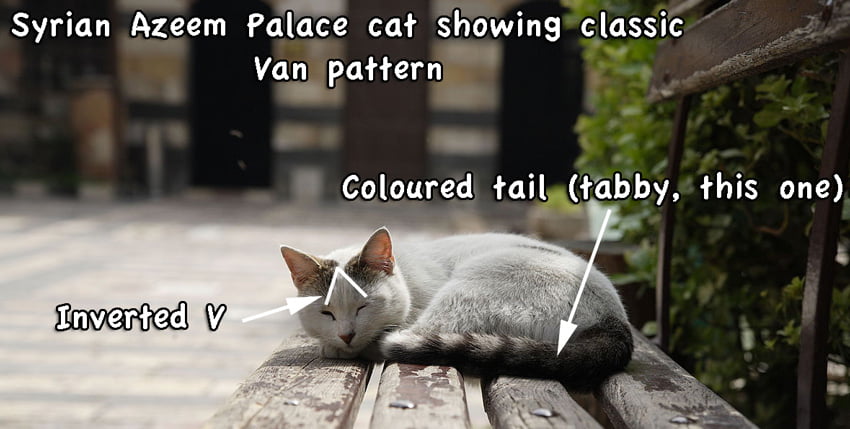
The Van pattern is named after Lake Van in eastern Turkey. It is close to Mount Ararat, the site of Noah’s Ark. Local legend says that when the Ark came to rest on the mountain after the flood receded and as the cats left the Ark they were blessed by Allah. The patch of auburn hair on the forehead and tail was were they were touched.
It is a very particular coat pattern. In summary it consists of a white body with coloured areas limited to the head and tail as seen in the photo above.
American Breed Standard
The Cat Fanciers’ Association breed standard for the Turkish Van defines what the Van pattern is. The cat’s body should be chalk white (due to the presence of the piebald gene – also called the white spotting gene) with an inverted V pattern around the ears and forehead and a coloured tail. The colours for the inverted V pattern and the tail are red (orange) black, blue (dilute black), cream (dilute red?). The colours can be solid or tabby. The association allows some dark spots on the chalk white body but prefer an all-white, clean looking body. The original colouring of the extremities was auburn (dark ginger) but breeding has added other color forms.
Turkish Van
It is the coat that adorns the Turkish Van cat according to the largest cat association in the world. The Van pattern is what distinguishes the Turkish Van from other cat breeds. Sometimes people refer to the ‘Van Cat’ which is a shortened name for the Turkish Van. In Turkey it is called the ‘Van Kedi’.
However, it is an slightly artificial breed standard. It is a Western creation probably born out of the fact that the first Van cats to make it to the West had these coat patterns. Lois Miles, an American cat breeder in 1989 felt that it was purely accidental that the original pair of Turkish Van cats brought back from Turkey to England in 1955 had the Van Pattern in auburn. These markings became enshrined as synonymous with this breed in the West but in Turkey this is far from the case.
Turkey
In Turkey, the Turkish Van is said to be the same cat as the Turkish Angora and you will see these cats in a wide range of colours and coat types. You will see the Van pattern but it is not the only coat type. Perhaps the Turkish people prefer predominantly white cats but that is not the only colour. In fact Dr Morris in Cat World tells us that when feline expert Roger Tabor visited Lake Van and discussed the breed with local people they considered an all-white animal to the the Turkish Van. Cats in Turkey with the Van Pattern were considered to be inferior.
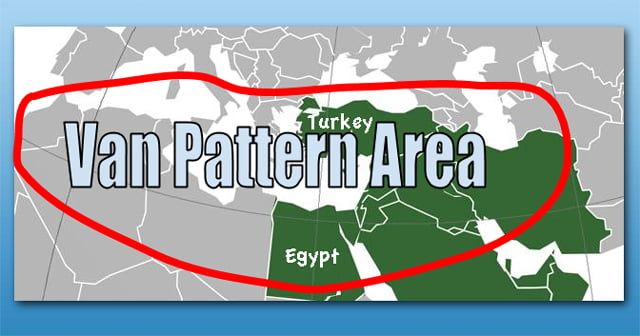
Whenever, I see pictures of street cats, also called community cats or feral cats, in the area I have selected in the maps below, I often see the Van pattern.
Mediterranean
The location of the origin of the Van pattern does seem to be centered around eastern Turkey but it spreads out substantially over many of the countries surrounding the Mediterranean Sea especially to the east and south.
That is my impression. It is not based on science and neither does the information come out of a book or website. It is simply what seems to be the case to me. I am happy to be corrected. Note: the pattern is not limited to this area. It just seems to be more common in this area.
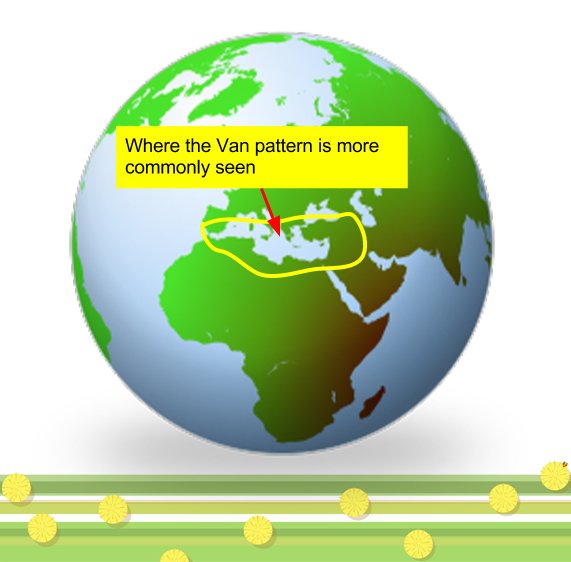
I don’t think you will find any text or maps about where you are most likely to see Van patterned cats, namely: to eastern and southern Mediterranean – i.e. North Africa. The map, below, that I have made indicates where I believe you are most likely to see the Van pattern.
Associated: Mediterranean Cats and The Cats of Morocco.
Updated, different or better map:
Note: this was republished and added to on 16th August 2018 to bring it forward for subscribers which is why the comments have different dates. Many of the early pages (this one was written 5 years go) become semi-invisible. However, this page is found by Google search and presents on page one.

I adopted a bother and sister pair. One has a van pattern and the other is full orange tabby. They were 2 of 4 kittens rescued from an outdoor colony in Scranton, PA. One of the other kittens also had the van pattern as well as an adult in the colony that was trapped. Not sure how this gene pool got there but he is a beautiful and sweet cat.
Yep, he is gorgeous. He has a very strong Van pattern so he has some Turkish Van genes but he is a random bred i.e. non-pedigree cat. That said he looks superb. You might call him a Turkish Van mix if you like! Sounds a bit better.
This is my kitty, Pants. He is a stray rescued several years ago and while I don’t know his exact age, I think he’s probably between 15-17 years old. What breed do you think? He seems to have the van pattern. Regardless, I love him tremendously!
Thank you for the fast reply!
It was surprising to see a cat with such perfect fur on the streets, but she was quite young when i found her so thankfully she didn’t spend a lot of time homeless! She had 4 other siblings, which looked almost exactly the same, which makes me think they must all have had the gene.
Yes, Maria, she has the Turkish Van coat gene although it has been modified it seems to me by other genes. Let’s say she has some Turkish Van in her which is not surprising because of where she lived. She is beautiful as you say. Super coat. A Mediterranean cat.
Pic