
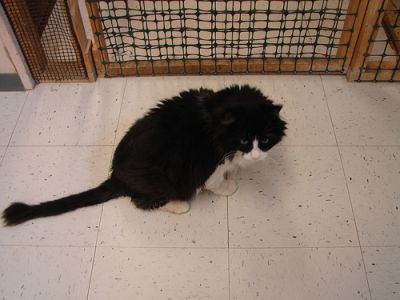
Photo: Tjflex2
A page about home treatment for cat constipation. I won’t describe the symptoms of constipation – we know them. Cats can suffer from the same problem. Some of the treatments are based on human treatments.
What happens
When feces are retained in the colon for two or three days they become hard and dry. This makes them painful and a struggle to eliminate (polite word). Normally a cat will poop once or twice a day and perhaps once every 2 days if on a low-residue diet. Most cats aren’t on this sort of diet so the standard once a day should be expected but less doesn’t mean constipation provided the stools are soft and normal.
{note: straining to go may be due to colitis or FUS – Feline Urologic Syndrome. These need to be ticked off in a diagnosis before treating for constipation – colitis is an inflammation of the colon or large intestine}
Some causes of constipation
- a low fiber and high in concentrated meat protein diet can cause constipation. This cause lends itself to a home treatment for cat constipation (src: Cat Owner’s Home Veterinary Handbook by Dr. Carlson and Dr. Giffin)
- a high fiber diet can result in larger stools, which in turn can lead to constipation (src: Your Cat by Dr. Hodgkins). This would seem to clash with the above but may not as both can cause constipation under certain conditions.
- hair balls are a common cause of hard stools.
- eating products/foods that are impossible to digest such as grass, cellulose, cloth and paper for example can result in compacted feces and constipation.
- the cat voluntarily overriding the urge to go to the toilet due to the presence of a number of factors and circumstances namely, strange surroundings (change in environment such as moving home), a refusal to use a dirty litter tray, going into a boarding cattery, a new cat in the house.
- Older and less active cats can have reduced bowel movements and weaker abdominal wall muscles.
- constipation is sometimes due to a condition called megacolon (this condition can also be caused by constipation). This is the permanent stretching of the colon and rectum. (see a veterinarian about this).
- another possible cause is pain because of a fractured hip or pelvis (caused by a road traffic accident, for example). A narrowing of the pelvic canal due to the healing process after an accident can cause constipation.
- a narrowing of the rectum due to polyps or small tumors can also produce constipation.
- I’m going to add my little contribution and say that inactivity can promote the onset of constipation. In other words it may be a factor which exacerbates the situation.
- cats on medication (antibiotics) could suffer from constipation as a side effect of the medication. A laxative (see below) may the answer.
- parasite infestations.
- not drinking enough water will compound problems.
- dehydration that can happen in cats with renal disease can cause constipation.
Cat constipation – Signs/Symptoms
If our cat uses a litter we’ll be familiar with our cat’s stools. As I have said previously you can tell quite a lot, as a layperson, about your cat’s health from his or her stools (yes I know it’s a bit gruesome but we have to monitor our cat’s health and this is one good way). If we are close to our cats (emotionally I mean) we can tell if something is wrong and indeed may notice her straining to go and not producing. Constipation is best dealt with early.
A cat with chronic constipation caused by fecal impaction often eliminate a watery almost liquid stool that could be mistaken for the opposite condition, diarrhea, when in fact it will be a liquid stool forced around the impacted stool in the colon.
Our cat won’t be going to the toilet as frequently or regularly. This should be readily apparent if like me you do the litter. She/he may also have a bloated and lethargic appearance and not eat as heartily as usual. She may look a little agitated around or in the litter and/or meow (in discomfort) when she goes.
Home treatments
Removing the conditions under which constipation occurs should ensure long term success. I’m going to initially refer to treating humans for constipation. The classic human treatment is to turn to a high fiber diet. In the UK that can be All Bran cereal and prunes – the classic old man’s breakfast! This and other high fiber foods will usually work, for humans, or at least help a lot and if not it’s down to laxatives, the milder the better initially.
Turning to cats. As a common cause of constipation is dietary (the first item in the list above) a change in diet would be called for as a good starting point for dealing with this condition.
The Cat Owner’s Home Veterinary Handbook has these recommendations:
- There are commercial high fiber cat foods, which are formulated for senior cats (I guess the food will be labeled accordingly). These cat foods contain more fiber and less fat than average commercial cat foods. If these fail to assist try Hill’s Science Diet Feline Light (I think this called “l/d”), which is a dry food or Hill’s Feline “w/d” or “r/d” (this one is expensive as far as I remember and at one time could only be bought at veterinarian surgeries). w/d and r/d is available in wet and dry food. Personally I would prefer the wet food as does Dr. Hodgkins who is the author of Your Cat and a cat food specialist veterinarian. Dry food places a requirement on the cat to drink more water, which may mean less water intake, which in turn can lead to urinary tract complications. This assessment is made through personal observation and experiences with my own cat companion. www.alternativepethealth.com recommend (more as a preventative measure when feeding dry food) to add a tablespoon of olive oil to the dry food. This may or may not be acceptable to our cat, however.
- Another form of home treatment for cat constipation recommended by the authors of the above book is to add bulk-producing laxative and fiber supplement such as Metamucil. This product is for people, which shows how similar certain illnesses suffered by cats are to those suffered by people. This product can be effective for mild constipation. Dare I say it I use something similar myself as I take medication that causes constipation. I use Fibre Sure (must be a UK product because of the spelling of Fibre). These laxatives work by absorbing water in the colon and soften the feces and promote defecation. Metamucil is an American product (I think) but available in the UK.
- Another product that would fall into the category of home treatment for cat constipation (and not mentioned in The Cat Owner’s Home Veterinary Handbook) is Nutrifyba 250g, which is a dietary supplement and which helps maintain normal bowel function.
Other forms of laxatives are “stimulant laxatives”. These may not be suitable for repeated, indefinite use. One such product is Katalax. This is designed to help remove hair balls and contains soft paraffin, cod live oil and malt extract. Another is Laxatone. This is bought in a tube and comes in Tuna flavor. This is an American product I believe and may not be available in the UK.
Addressing the other causes above:
4. Removing “disruptions” in the life of a cat (cats like routines) is another useful form of home treatment for cat constipation. Although new events are sometimes unavoidable they will or should resolve over time whereupon the cat will settle. A mild laxative as referred to above may suffice.
5. Regular brushing/grooming by us, particularly for a long haired cat, is essential really and will help minimize hair balls one cause of constipation.
6. Clearly a well cared for litter tray is a prerequisite to remove any possibility that the cat is voluntarily not going due to inadequate toilet facilities. In addition, as much exercise as possible is always good for health and can aid the digestive tract and bowel movement. I can speak from personal experience……
7. Long term, if we are up to it, perhaps the perfect dietary remedy is to make our own cat food from raw products. Although this must be done to a good standard and with the proper supplements to replicate a wild cat’s prey. I made a post about this here and another here: raw food diet.
8. Plenty of play, human and/or other cat or pet interaction will help keep our cats exercised and important factor in preventing constipation.
9. Other products to consider (type these – one at a time – into Google search to find suppliers). These are herbal and natural remedies and supplements etc.:
- Purrfectly Natural Gourmet is recommended (USA only?)
- PetAlive Natural Moves(available in the UK and USA)–Pet Essences (UK available)
- King Bio Natural Medicine (USA) explore the website
- onlynaturalpet.com (USA) explore the website for remedies
Other causes can only be dealt with by a veterinarian, who should be consulted if in any doubt.
Update March 2011: A visitor shared her experience in using mineral oil mixed with we cat food
Home treatment for cat constipation – Other sources: alternativepethealth.com
Note: Photo: this cat is (or “was”, but I really hope that he is still alive – the photo taken 2 years ago) called Babado. He had a neurological disorder that caused symptoms including constipation. He is a survivor. He is photographed in a cat shelter. He is a character. I like this cat a lot. I want to give him a kiss.
Finally, there is a great page on cat constipation on the Simple Wag website. Visit it by clicking on this link.

That is a nice tip. Appreciated.
Actually I give a half of teaspoon of baby squash a day to my kitties and it works like a charm!
Thanks, Doug for a comprehensive and very informative comment.
Try these if nothing else works. They fixed my kitty.. who was struggling with hard stools:
1. Docusate sodium (STOOL SOFTENER CAPSULES): this is the active ingredient used in STOOL SOFTENER CAPSULES for humans, available at any grocery or drug store. This is the EXACT SAME ingredient used in stool softener capsules for cats! It’s safe to use and you DO NOT need a prescription from a vet to buy this! Dosage: 1 pill per day (100mg)(I gave my kitty 2 on the first day). You will need to learn how to get your cat to swallow a pill, if you’ve never done this before. Tip: sit down, put cat between your legs, fold your legs behind its butt so it can’t squirm away, gently pry open its mouth (they’ll never voluntarily swallow a pill), stick pill on tongue (slightly back in mouth), close up mouth and hold their head up until they swallow.
2. Shaved turkey breast (deli style) and PUMPKIN: My cat refused to eat his canned food if there was even just a *hint* of pumpkin in there. The trick is to stick a blob of PUMPKIN on a small piece of deli-style shaved turkey breast. Fold the breast over and around the pumpkin on all sides, so the pumpkin is mostly contained inside. Wrap that into another small piece of turkey breast. If your cat is like mine, it won’t be able to resist the turkey meat. It will want to eat all of the turkey meat, and will not be able to figure out a way to get rid of the pesky pumpkin besides licking it off the turkey. Really, it won’t mind the pumpkin at all, as long as there is shaved turkey breast to be had. Mission accomplished!
3. You should also ADD WATER to your cat’s canned food (mix it in) and do not give them any more dry food (especially if they are older). Dry food will only make the problem re-appear.
Follow these tips and your kitty will thank you.. and everyone will be relieved (especially your kitty!)
I will presume that Hightops has shown signs of constipation (a) infrequent passage of small and hard stool and (b) straining to pass feces.
However, straining can occur with colitis (inflammation of colon) and urinary tract disease FLUTD.
It is wise to check that your cat is not suffering from these conditions before treating for constipation. UTIs are commonplace. UTIs can be serious. Is Hightops urinating OK? You should be able to tell quite easily for an indoor cat because the litter will clearly indicate this. I presume you have a handle on all this.
Apparently Laxatone is particularly good for hairballs. However the books say that if there is an obstruction in the colon Laxatone should not be used. It might be wise to reconsider using it as the distended abdomen may indicate a blockage..
“Bulk laxatives” are useful. I may have mentioned these in the article. They can be used indefinitely while Laxatone should not as it can reduce bowel action.
Lactulose can be helpful. Also: Wheat bran, 1 tablespoon per day, or canned plain pumpkin, 1 teaspoon 2x per day are suggestions made by the authors of the book referred to in the article.
Good luck with Hightops. There are several causes of a bloated abdomen one of which is a blockage as you imply. I’ll do a page on distended abdomens today.
For the last couple of days we have noticed our indoor cat acting odd, tonight though my husband went to feed her and her tummy is swollen, and she can hardly walk, but she seems fine , like her eyes don’t look hazey or anything, we can not take her in till the ,middle of next week, so we are trying the Laxatone, I am hoping and praying she will be alright. Our Hightops is approx 10 or 11 yrs old. We are both so worried. She is also spayed.