
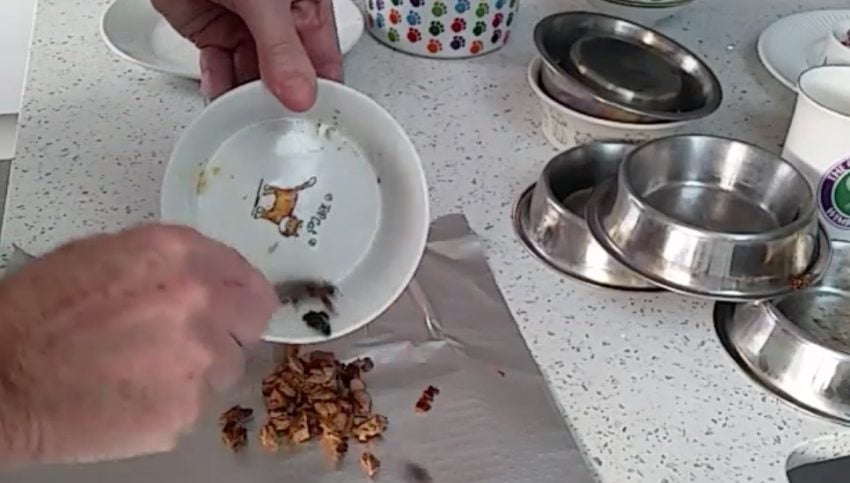
For me, and I might not be entirely typical (an understatement!), one of the great problems of getting rid of uneaten cat food is that if you put it in a plastic bag and put that bag into the rubbish bin it can still smell. It is particularly bad in warm weather for obvious reasons. The smell is very pervasive and difficult to contain.
Plastic bags don’t seem to be able to contain the smell. Also, plastic bags are both environmentally unfriendly in terms of manufacture and landfill. There is a pressing need nowadays to minimise the use plastic bags in whatever context and certainly in terms of being discarded.
Where I live, we are meant to recycle waste food by placing it in a small container. However, it’s impractical I believe. The only waste food from my house is cat food and if it’s placed in the container, it attracts flies and then there are maggots and a horrible smell. That’s why I developed an alternative method. Note: this is a last resort. There is a method I discuss below which should minimise cat food waste. Clearly the objective is to totally eliminate wet cat food waste.
Note: please see the update at the end of the article.
A further point about putting waste cat food into plastic bags that it is not as convenient as doing it the way I demonstrate in the video.
As a last resort in using aluminium foil, it is easier to scrape out the cat food and put it onto the foil. In landfill, aluminium foil oxidises down in about 500 years and there’s no leaching out of chemicals into the soil. It biodegrades cleanly and safely. It returns from whence it come so to speak. Plastic takes both a thousand years to biodegrade and is more environmentally polluting because chemicals leach out into the surrounding landscape.
The foil also keeps the smells well contained. It is 100% successful in this regard. I’d like to hear your views on it although as mentioned at the beginning of this article you might find what I’m doing slightly mad. And you may disagree on the environmental issues.
I find that inevitably there is some waste. Often my cat eats the entire contents of the bowl but not always. I have found this with all my cat companions despite my best efforts to avoid waste. Perhaps this is one reason why dry cat food is such a successful product commercially.
Another follow up point: If my cat does not eat his wet cat food at all or partly, I put it in the garden in the cat food bowl that he rejected. This food will be eaten by the cat or a wild animal. Sometimes cat that reject wet food inside the home accept it outside the home when they behave like scavengers. This method obviously depends on the cat being an indoor-outdoor cat.
Update: I have an infographic on minimizing cat food waste:


Nice recycling. We don’t have any animals in the UK to recycle it to. I don’t think we do.
I combine all of my cat food remnants daily and put out nightly for raccoons, armadillos, and opossums.
We put any leftovers out for the opossum family. They come every night to check out the menu.
We’ve not had any pongs, maggots, flies or stinks since the recycling started. Neither of us could put up with any of that.
Flush it down the bog!
They actually provide a small container but it attracts flies and then I get maggots and it pongs. I have to do this to make it manageable. Perhaps others don’t care about ponging, maggot infested waste food buckets (which I only use for waste cat food as I have no waste human food or almost none) but I do. The technique you see deals with the issues but I can’t throw it in the waste food container or don’t believe I can.
Do your local ‘rotten borough’ not insist on food waste recycling weekly? What on earth do they spend your no doubt huge Council Tax payment on? Lobby them!
I thought it was a nationwide, council thang?
Ours do recycling collections weekly. They provide a food waste kitchen caddy, with secure lid. All food waste, cooked/raw goes in there. We line ours with compostable bags to avoid a sloppy, stinky mess. When the caddy is full, we tie a knot in the bag, then it goes outside into a fox/dog/cat/rodent proof lidded, larger caddy.
The caddies, small & large are remarkably good at containing stink. You do need to wash them weekly, hot water and washing up liquid will do the job. If you do that, no flies either.
Before the advent of recycling, any uneaten wet cat food was flushed down the toilet. Wet cat food is probably already more processed than er, human waste. It flushed fine. No blockages either.