
The word “torbie” is a shortened version of “tortoiseshell-tabby”. The word describes a coat that is an amalgam of tabby patterns/colors and tortoiseshell patterns/colors. Both pedigree cats and moggies have torbie coats. The black areas are replaced by dark tabby patterning. They are also known as a ‘patched tabby’.
To people unsure about cat coats, torbie looks like a spelling mistake. There is a “b” where there is usually a “t” as we are used to seeing “tortie” cats (short for tortoiseshell).
So, what does a torbie cat look like? Here are some examples. The coat patterns and colors are quite subtle, I think you’ll agree. For example, tabby stripes on a tortoiseshell coat sounds fairly easy to visualize but when you see the coat it is not so straightforward.

Other names for a torbie are:
- Patched tabby. This describes a tabby cat with patches of cream and red fur.
- Tortie tabby.
How do you identify a torbie? The silver classic torbie in the picture above is fairly easy to pick out because you can clearly see the classic tabby pattern of swirls etc. as well as the red fur which is what you see in the tortoiseshell cat.
I think the key is that you are looking for some red or orange within a tabby pattern of some sort, be it, spotted, stripped (mackerel) or swirls and blotches (classic). For example, in the cat described as a brown mackerel torbie in the picture above (second from bottom on the left), you can clearly see the stripped tabby pattern and just about see the red in the coat.
It is easier to see the tabby pattern. If you have that and no red the cat is probably a straightforward tabby cat. Apparently torbie cats have spotted bellies (as do tabby cats) whereas a tortoiseshell does not.
You can get some complex color mixes with torbie cats. There are silvered, non-silvered, golden, and chinchilla or shaded silver/golden. You can add white to these patterns too.
Here is an interesting type of torbie cat. This cat has torbie pointing. Seal colored torbie pointing is standard colored solid pointing that has been “broken up” by making it tabby pointing and tortoiseshell pointing combined. When pointing is just tabby pointing it is called “lynx pointing”. It’s a bit complicated, isn’t it?
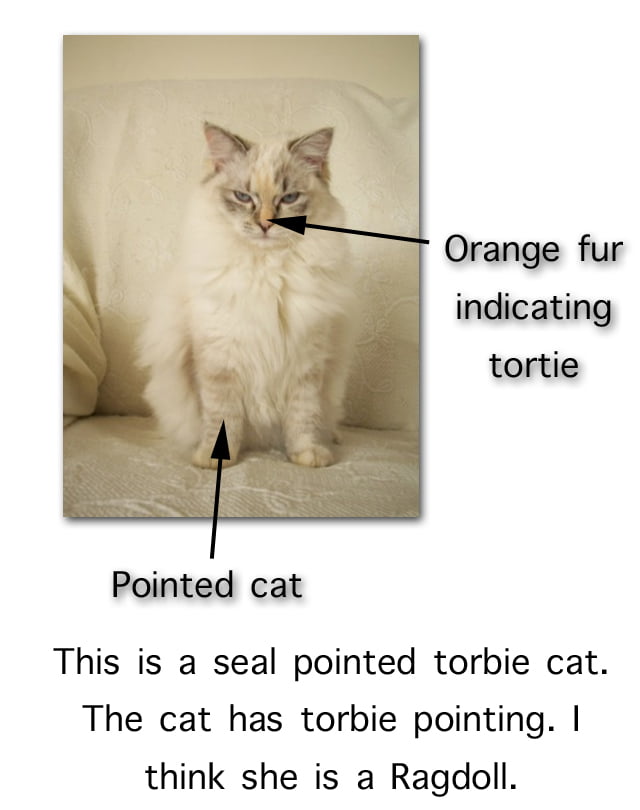
Because there are two coat types interacting there is a very wide range of color+pattern effects in torbie cats.
There is nothing about the genetics of torbie cats in the what is supposedly the best book on cat genetics: Robinson’s Genetics. Actually, it is a poorly written and prepared book.

One final point; some people believe that calico and tortoiseshell cats have a certain personality or attitude. I am not sure. However, if they are correct then torbies also have an attitude and the attitude is that they have an opinion and are not afraid to voice it.
This connection between tortoiseshell coats and ‘catitude’ is born out in the character of my friend’s cat. She is a little, independent-minded feline. She looks like an old opinionated granny!

Bimetallic (known as”sunshine” in Siberians – the only breed where it occurs) would not have the colours intermixed like this. I have seen other torbies with this sort of pattern and it is just luck of the draw which X-chromosome is inactivated in which cells that produce the pattern and what sort of patches those cells grow into.
This is a pretty, but normal, expression of tortie-tabby. The red and black areas are intermixed rather than distinctly patched – this produces a coat that is almost like a wildcat.
The intermixing gives the effect of a rainbow-coloured cat because the red colours are variable in tone. If you looked at individual hairs, you’ll find red, banded-red, black, banded-black, cream and banded cream hairs.
Chimera is unlikely because this coat can be easily explained using normal colour genetics.
And this..
Here is a couple more pictures of her I had to resize to be able to upload.
Thank you for your quick comment Michael, I appreciate it. Could be she’s also got some bimetallic color going on there also, but she’s got definite cinnamon Orange coloring on her back, like a handprint size worth, and also cream colored tortoise shell toes on a few toes. This picture is from her younger time before the plush hair length filled in and made her underlying pattern harder to see. I know her mother is a blue cream medium length haired tortoise shell, and I’m pretty sure her father was a short haired Orange tabby. Also, I got her from my daughter’s friend who was very irresponsible and the poor mother cat had many litters of kittens and there was ALOT of inbreeding going on there. Sassy and her litter mate brother were the only 2 patterned (classic) kittens ever born from this mother, with her brother lacking the bright orange that this cat has. Sassys mother is also her distant sister and I think the father is also a brother of the mother somewhere down the line. I meant to type “huge” up there, not hug. She’s 17lbs and twice the size of my Bengal, whom I never considered a small cat. She’s just Chuck full of tortitude, extremely smart, and has tons of personality. So, that’s a bit of what I know about her background. Thank you again. I do hope to hear from the messy beast site owner, because I spent alot of time on there when I first got her trying to figure her out.
A fascinating coat. I don’t recall seeing a coat like this. I wonder if your cat is “bimetallic”.
If you click on a link below you can see an article about bimetallic cats.
https://pictures-of-cats.org/bimetallic-cats.html
Thank you very much for showing us your cat. I think that you will get a good answer from Sarah Hartwell who is a cat genetics expert and who runs the messybeast.com website. I’m not sure that I can give you a really good answer. I will see if I can encourage her to make a comment.