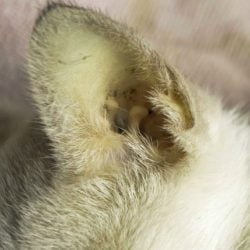
The two pictures on this page show us the satellite-dish ears of the serval, a lanky, medium-sized wild cat species. The pictures show youngsters and the ears are proportionally larger making them very noticeable. “The servals long legs [the longest legs in proportion to body size of all the wild cat species] provide its …
Whereas humans can hear up to 20,000 cycles per second (cps) or 20kHz, cats can detect sounds as high as 60,000 to 80,000 cps (80kHz). At the low end of audible frequencies cats hear between 20 and 55 cps (20-55 Hz). Humans have a similar ability to detect low frequency sound. The cat’s ability …
Yes, domestic cats hate loud music and shouting. These loud sounds are torture to the cat’s delicate hearing apparatus. A cat’s ears are much more sensitive to sound than the ears of his or her owner. They hate noisy homes. Most cat owners who are switched on realize this. They try and keep their …
Yes, cat ears are supposed to be hot for the simple reason that the blood vessels in the ear flaps are very near the surface and there is very little hair or fat between a person’s touch and the ear. Therefore, you are almost feeling the body temperature of the cat via the blood. …
The photo looks genuine but when I look at it I can’t believe it is real! It is strange. I can’t see any photo editing but perhaps someone better than me will correct me. On the basis that this photo is genuine, this black-and-white moggie has extraordinary ears. There is nothing else on the …
Because the domestic cat has 32 ear muscles compared to our measly six, (s)he can move the outer parts of each ear (the ear flap or pinna) through about 180 degrees. In addition each ear can be moved independently of the other. The cat can therefore hear sounds all around his body without moving …
Ocelli, in relation to wild cats, refers to round, white or light-colored, eye-spots on the back of the ears (the ear flaps – ‘pinnae‘). “Ocellus” is the singular. The most common example is on the wings of butterflies. For domestic cats you might see a faint version of it on tabby cats because the …
If your cat’s eats are hot to the touch, veterinarian sites will say that your cat might have a fever. I’ll touch on that later in the article but one point that is rarely made is that a cat’s ear (the ear flap or pinna) has very little fur on it and it is …
Note: Some older videos on this page were hosted on Vimeo. That account has now been retired, so a few video blocks may appear blank. Thanks for understanding — there’s still plenty of cat content to enjoy!