The hearing range of the domestic cat is one of the broadest among all the mammals. A study published in 1985 concluded that “the hearing range of the cat for sounds of 70 dB extends from 48 Hz to 85 kHz, giving it one of the broadest hearing ranges among mammals.” They further concluded …
If you are a native English speaker, you have probably heard the of saying “have eyes in the back of your head”. It applies to a person who is aware of what is going on behind them and around them generally. Some people are more aware of events happening around them than others because …
Tail muscles mainly consist of the following 6 on both sides: M. sacrocaudalis dorsalis medialis (SDM); M. sacrocaudalis dorsalis lateralis (SDL); M. coccygeus lateralis (CL); M. coccygeus medialis (CM); M. sacrocaudalis ventralis lateralis (SVL) and M. sacrocaudalis ventralis medialis (SVM) The sacrocaudals and intertransversarials raise, lower and curl the cat’s tail. The cat’s ear …
Here is a picture of a part of the domestic cat anatomy that is semi-abstract because the ears are so strange. The image immediately appealed to me as suitable to make a puzzling picture. They are the ears of an Elf cat – a dwarf hairless cat with curled back ears because they are …
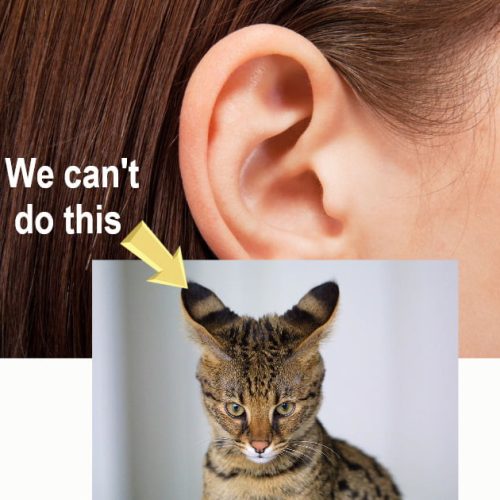
We know how mobile the visible part of the cat’s ear is. They have over 30 muscles to move their ear flaps (pinnae). They often listen to sounds behind them without turning their head towards the sound. It’s impressive and it looks as if they don’t care about you when you are talking to …
By ‘better’ I presume that the question refers to being able to hear a wider range of frequences in which case the answer is as follows: As cats do not produce ultrasonic calls (sounds above 20 kHz), their ability to detect sounds well into the ultrasonic range is probably related to hunting prey which …
What are lynx ear tufts? Answer: they are tufts of hair (a bunch of hairs growing together) emerging out of the top of the ear flaps (pinnae) of the cat. The word ‘lynx’ in the description refers to the lynx wild cat (4 species1) which has classic tufts of hair growing out of the …
Cats can hear ultrasound to enhance their ability to detect high-frequency sounds produced by rodents which communicate in the 20-50 kHz range (mouse squeaks). Small cats are therefore well-equipped to detect the sounds of their prey. Ultrasound is sound waves with frequencies higher than the upper audible limit of human hearing. The upper limit …
Note: Some older videos on this page were hosted on Vimeo. That account has now been retired, so a few video blocks may appear blank. Thanks for understanding — there’s still plenty of cat content to enjoy!