There has been a long discussion on the internet about the reasons why domestic cats eat grass. Many years go, Dr Desmond Morris suggested that domestic cats ate grass to ingest folic acid in the grass to aid in digestion. A study carried out at the University of California, Davis, School of Veterinary Medicine: …
The relocation of shelter animals often by air is commonplace in America. It’s a great idea as it leads to more adoptions and the saving of lives. Craig Prior, a Nashville-based veterinarian with the non-profit Companion Animal Parasite Council (CAPC) makes the point that there is a shortage of shelter animals for adoption in …
by Mrs Brewer My 1yr old inside female cat has something coming out of butt. They look like rice they are like off white color. I need to know WHAT this is and can my other animals get this? I’m also worried that my 2-month-old son will get sick from this! I don’t know …
Presumption The first point to make is that it’s probably sensible to make a presumption that your cat has worms if she is an indoor/outdoor cat. She’s likely to hunt and eat mice and in doing so ingest worms. The particular worms I am referring to are roundworms (ascarids). They are the most common …
Do worms cause pain in cats? If the gastrointestinal parasitic infestation reaches a certain level it causes illness in the cat. Before that the cat will feel no pain. However if she becomes ill there will be a decline in general health, a decreased appetite, loss of weight, possibly vomiting, diarrhoea and anaemia. A …
It is advisable to de-worm your cat under veterinary supervision. The reasons are (1) no medication is effective against all types of worm and therefore a proper diagnosis is required and (2) medication needs to be given precisely as directed by your veterinarian and (3) “natural” side effects such as vomiting and diarrhoea need …
Yes, worms can kill kittens. A heavy infestation of ascarids (roundworms) can result in severe illness and possibly death. A hookworm infestation can be fatal in very young kittens. In all, although some are rare, there are ten different types of parasitic worm which can infect a cat: roundworm, hookworm, tapeworm, roundworm (trichinosis), strongyloides, …
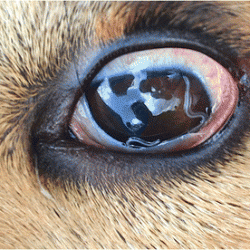
There is an interesting article in the Times today, Wednesday, September 20th reporting on a parasitic worm that can blind pets. The report concerns three British dogs infected with Oriental eye worm but both humans and cats are also at risk. Scientists recommend that all pets travelling to high-risk areas be given preventative eyedrops. …
Note: Some older videos on this page were hosted on Vimeo. That account has now been retired, so a few video blocks may appear blank. Thanks for understanding — there’s still plenty of cat content to enjoy!