
You could categorize cat personalities into two types:
- confident, bold and outgoing
- timid, shy and retiring
A confident cat is more likely to be a friendly cat as they are more outgoing. They are less fearful than shy cats. Bold cats are naturally more friendly. Of the purebred cats, Siamese are rated as friendly and sociable. Pedigree cats are said to be friendlier than non-pedigree cats. Although this is a generalization and based on one study, as far as I am aware. Is the Sphynx more friendly than the Siamese?
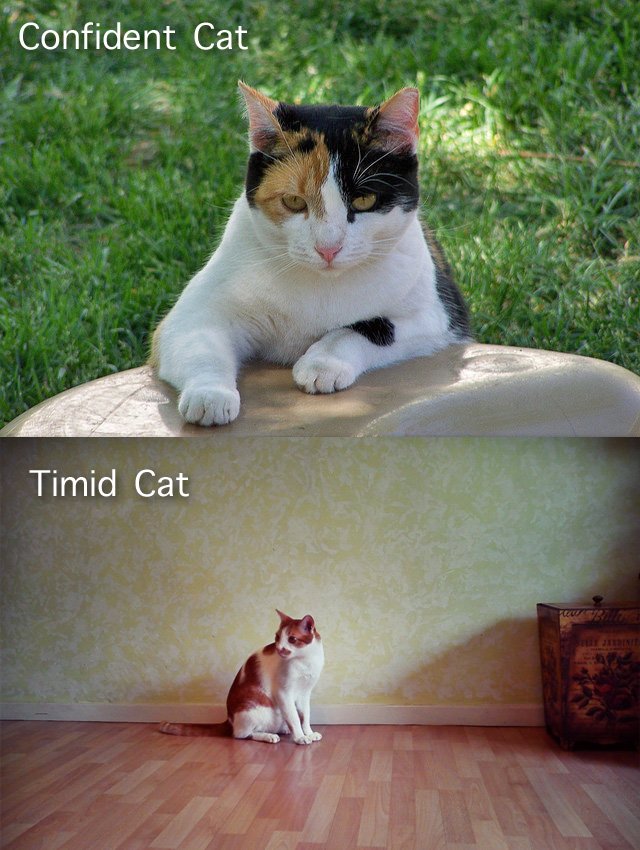
Animal experts advise people who adopt from shelters to choose a bold, friendly cat. If you put your hand in the cage of a shelter cat, the kitten or cat might come up to your hand, sniff it and rub against it. Alternatively, she may remain at the rear of the cage and be fearful.
Or you can go to a room with a selection of cats and see which one comes to you. If a cat plays with you and is immediately friendly, the selection process is complete.
But is it? Are timid, shy cats to be consigned to the cat dustbin or garbage bin of life? Are all timid cats just waiting to be euthanised at cat shelters? Isn’t it fairer to adopt a timid cat and make that cat, through love, play and attention, less timid and more confident?
When an expert advises people to only adopt the confident cat it is like a consumer magazine or a website rating and reviewing products. The best cat is confident; the worst cat is timid. The best washing machine is Miele; the worst is Zanussi. The thing about cats is that they are living creatures and any “defects in manufacturing” can often be rectified over time through gently rehabilitation and socialisation. I am not saying it will be easy or that there will a guaranteed result. However, it is very satisfying to bring on a timid cat and she her flourish and develop into a more confident one.
Also a timid cat can actually be more suited to some people and some situations. Fearful cats are less likely to chase out of the house or get into trouble etc. They are more passive and possibly less demanding. This will certainly suit many people.
My advice is not to take the advice of so-called cat and animal experts all the time. Yes, most people will prefer the outgoing cat. But many people will prefer a shy little thing who needs a human hand to lead her to a more confident and contented life. There is a lot of pleasure in nurturing a cat along. There is peace of mind, too, in knowing that your timid cat is likely to be less demanding of space and adventure.
Also, it seems to me that once you have been granted the confidence of a shy cat, he/she is going to be very attached and loyal to you. They are “one cat” household cats.
Note: Black cats are meant to be more laid-back. Orange male cats are said to be more aggressive than black cats. I think orange cats are generally more confident.
How do you make a timid cat more confident? A timid cat/kitten is probably like that because of inadequate socialisation. This means the kitten, in early life, was not around people and household noises and activities etc. Most breeders will put their kittens in their own homes. People visit and there is the usual interaction with other pets and people. This makes cats relaxed and that equates to confidence in the human home and environs.
Common sense dictates that a shy cat needs to be brought on gently by plenty of play and interaction with his new owner and perhaps other pets. It is harder to socialise (at least to a certain extent) a cat later in life but not impossible. It is the same with feral cats. They can often be domesticated. They are an extreme example. A shy domestic cat should be much easier.
If a cat is shy because of prior bad experiences, then over the long term, a quiet, secure and peaceful environment with excellent food and no unexpected noises etc. should bring the cat out of her shell. Patience and acceptance is the byword.

I think you split up ‘shy’ perfectly there into a few things the initial word might have been interpreted from. Aloof, timid, fearful, and so on. My cat Red could have been mistaken for shy actually, but it was more that he was aloof actually. And I totally agree with what is concluded from your comment that whichever type of character one might see in a cat to begin with (that might have come accross as shy in simplistic terms) – might be the basis for a very good natured cat in the future once he or she has grown up a bit – and that nice trait is far from shy, perhaps laid back and without need to be first or in front of other cats in the household. It’s not shy, it might well just be polite:)
Yes, and sometimes a timid cat will approach the person she/he wants as their companion. Perhaps they can tell who is friendly and who won’t hurt them.
Look into the eyes and adopt the one that speaks to your heart. It may be shy or it may be friendly. If you listen to what your heart is telling you then you’ll make the right decision.
I like your additional thoughts. Very good indeed. Monty is a nice balance. It is good for a cat to be a bit nervous and lack some confidence because it stops him/her getting into situations that can hurt or kill him/her. This is good for human and cat. It is also peace of mind for the human. I remember Helmi and Ken Flick talking about an F1 Chausie (jungle cat wild cat hybrid) they kept for a while. He was extremely confident and active and he was impossible to keep as a pet! Almost. The more active and confident, the more input the cat needs from the human. In short the more bold, the more demanding the cat becomes. Do you want that? Some people do and some don’t.
You are a cat lover and a kind person and was drawn to helping a cat who needed help. You then got your reward in seeing her become more confident and bonding really nicely. Yours is a classic example of the good things about adopting a retiring and shy cat and going against the conventional advice of cat experts.
As I’ve said before in comments, Tootsie my Maine Coon rescue cat, had a very discouraging description via Petfinder. Shy, needs patient person, etc. etc.
I was okay with that. I’d pretty much made up my mind before I met her. But, I do remember thinking, when I saw her stretched out against the back wall of the enclosure something like “Oh, Tootsie, Beauty Cat, I just can’t leave you here to suffer”.
It has been so gratifying to see how much she’s progressed since I adopted her. She was 6 yo at the time. I think she’s now a pretty happy cat, and she trusts me. I’ve always been a “cat person”, but creating that bond taught me so much more about cat behavior than I’d known before.