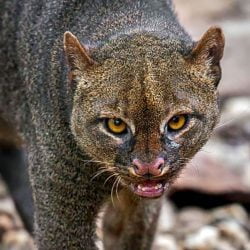
We don’t have a f***king clue as to the number of Jaguarundis that are left in the world. Yep, it’s true. It looks to me as if people have given up, what I mean is the people who are meant to not give up, the conservationists, the people who are concerned about protecting wildlife. …
If you are lucky enough to see a jaguarundi in Arizona it will be an escaped captive animal. It will not be a genuine wild cat living in the wild in that state of America. The most up-to-date map of the distribution of the jaguarundi on planet Earth tells me that this small wild …
The jaguarundi eats about 105 grams of food per day on average. This is 3.7 ounces. Neither my books nor the Internet tells me in terms of weight how much a jaguarundi eats per day but we can work it out. The jaguarundi is a similar size to the domestic cat. It’s a bit …
Officially, there are no jaguarundi in Florida as the map below shows: Anecdotally, you will hear about sightings of jaguarundi in Florida from time to time. Perhaps there are some in this sunny state because they were released from a private zoo. These are the countries at 2014 (the latest information available) where this …
Are jaguarundi dangerous to humans? Under nearly all circumstances in the wild jaguarundis are not dangerous to humans as they are small wild cats. They’d normally run a mile from humans. There have been no records of humans being attacked by a jaguarundi in the wild as far as I know. My reference book …
People ask Messrs Google if it is a good idea to adopt a jaguarundi as a pet cat. I guess they think it is possible because they are a small wild cat and people like the look of small wild cats. Their interest in the idea comes from the cat’s exotic appearance. The trouble …
Are jaguarundis nocturnal? No, they are not exclusively nocturnal. Jaguarundis have been recorded moving around and hunting at all times of the day and night (sources: 1, 2 and 3). However, it appears that this strange looking wild cat prefers to hunt by day (diurnal). The cat’s uniform coat indicates a ‘more diurnal lifestyle’ …
In 2019, the main threat to the jaguarundi is habitat loss and the fact that its distribution is fragmented and in these fragmented areas the population sizes are low. It is said that none of the conservation units (with one exception – the megareserves of the Amazon Basin) can sustain long term viable populations …
Note: Some older videos on this page were hosted on Vimeo. That account has now been retired, so a few video blocks may appear blank. Thanks for understanding — there’s still plenty of cat content to enjoy!