
The domestication of the cat is an ongoing process. Domestication still takes place. The domestic cat is still very close to the wild cat in terms of behaviour and its genetic make up because, it is believed, that about 15 or 20 genes separate domestic cats from their wild relatives.

Dr John Bradshaw1 of Bristol University states:
“It is probably the smallest difference there is genetically between a domestic animal and its wild counterpart.”
He goes on to state that it wouldn’t take much to reverse the process, stall it or upset it.
The castration of good well raised middle-class domestic cats means they can’t produce offspring but wild tomcats can. Result? Lower numbers of domesticated cats.
Dr Bradshaw poses the theory that in the United Kingdom, in some places, as many as 99% of male cats are neutered. Obviously neutered cats can’t procreate. The only cats who can procreate are feral cats or stray cats in the process of becoming feral cats, of which there are an estimated 1,000,000. You hardly see them. I never see them! But they are there, unowned tomcats who are whole and healthy. They have not been castrated and as a consequence they desire to procreate and they succeed. By doing so they pass on their less domesticated genetic make up to their offspring. Bit by bit, the theory goes, the domestic cat becomes less domesticated; the evolutionary process of domestication is reversed.
The domestic cat is chosen because he or she is docile and has learned to become sociable and live in human households whereas the feral cat has completely different attributes, namely, a high proficiency in hunting and fighting and staying away from humans.
I can see the argument. It makes sense and is logical but I wonder whether it is a genuine problem or simply a theoretical problem. If Dr Bradshaw is correct it should be a wake up call to more intensive government managed trap-neuter-release (TNR) programmes.
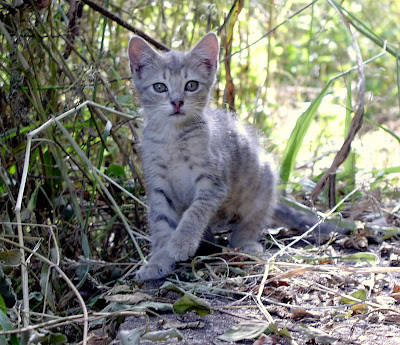
The photo above is of Adele a feral kitten looked after by Bob Tucker in the USA.
The Perfect Domestic Cat?
On a different note, because there is such a small number of genes which make the difference between wild cats and domestic cats it might not be too hard in theory to breed the perfect cat.
The argument behind this proposition is this. Dr Bradshaw believes that about 7 or 8 genes affect the behaviour of the domestic cat. These are inherited behavioural traits. Behaviour is of course also affected by environmental issues in the early stages of a cat’s life.
Scientists will be able, in the not too distant future, to know what these genes do and thereby identify the friendliest cats genetically.
Once they are able to do that they will be able to selectively breed (or create in a laboratory) for the perfect cat. My immediate thoughts about this not good. I don’t like interfering with nature and you can see how this could all go wrong. In theory, it should go right but humankind has a tendency to abuse this sort of information in furtherance of its own self interests.
Dr Bradshaw is more optimistic. He says that selecting cats genetically for their friendly traits would mean that people would be able to select cats that are more suited to modern urban living. More and more people are living in the urban environment which is less suited to the domestic cat than the country environment. The urban cat needs to be more domesticated in order to be less stressed. There will be many more full-time indoor cats in the UK. People owe it to the domestic cats to ensure that they are suited to modern human living. That’s the argument. What do you think?
Note: 1 Dr Bradshaw wrote the book: Cat Sense: The Feline Enigma Revealed (ISBN-13: 978-1846145940).

Neither of them will go hungry as long as Babz and I draw breath, nor will the unfortunate cats around us 😉 and the cats at Kays Hill.
Maybe Jozef would leave some for Walter if they were together, he often leaves him a mouse when he’s finished with it. But Walt never ever eats any prey although I expect he would if he was starving.
Oh wow Harvey they are beautiful so precious!! You seem to do an amazing job, good on you. Look at those beautiful blue eyes. 🙂
Its the responsible thing to do to Get your animal Fixed all mine been fixed. Jasmine is getting done in two more months. I wouldn’t have it any other way!! As its not fair for the cat to have kittens. Even just for one term, as we know the cat can have kittens again after shes had them. I know Jasmine would have beautiful Kittens. I was just put off when my sister cat had kittens,just seeing how badly she refused her babies, she got an infection. It was horrible. So that’s why i think its the best thing to fix all females or males as there so many kittens in shelters wanting homes and breaks my heart when they have to be put down. I cant save them all which is more heartbreaking than anything. Sorry for long comment. 🙂
The key is to neuter as many feral cats as domestic cats. We are a long way from that ideal.
Very well said. You have highlighted something I didn’t realise. It is strange. In America, their fake version of the Turkish Angora is preserved through breeding cats and registrations etc. but the genuine article in Turkey is under threat through neutering.