The question is inherently incorrect! Evolution dictates the length of cats’ tails and evolution is always correct in the very long-term. Tails are functional and they have to be at a certain length in order to carry out the function for which they are designed. The function of the tail is to help provide …
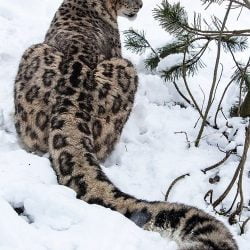
Snow leopards do not ‘bite’ their tails to keep their nose warm as has been stated. Neither do they bite their tails in an aggressively harmful way. They don’t even bite their tails. They hold their tails in their mouths because they enjoy doing it as a distracting diversion, as a comforter, or as …
Bobcats cannot have long tails. All true bobcats have a genetic mutation which shortens the length of the tail. The tail is usually about 14 cm long (5 inches).
If you are a native English speaker, you have probably heard the of saying “have eyes in the back of your head”. It applies to a person who is aware of what is going on behind them and around them generally. Some people are more aware of events happening around them than others because …
Yes, they certainly can break and it is not uncommon. This is because a cat’s tail is made up of bones (19-21), nerves, muscles, skin, cartilage and hair like many other areas of a cat’s body. A cat’s spinal cord does not extend into the tail but many nerves extend from the spinal cord …
This is a Pixie-bob from the Legend Tales breeder. They have been breeding the Pixie-bob since 1996. They call the cat breed ‘the Golden Retriever of Cats’. That must mean the Pixie-bob likes playing fetch. Some cats do. I have a page on the breed which you can read by clicking here. It is …
A cat’s tail is made of bone (caudal vertebrae), ligaments, tendons, cartilage, muscle, skin and hair. A typical cat has between twenty-one and twenty-three caudal vertebrae which are extension of the spine. Exceptionally a cat with a full tail may have as few as eighteen or as many as twenty-eight of these bones. They …
The answer is fairly straightforward. They have big ears because most of their hunting takes place in long grass detecting small mammals with their ears. They can pick up the sound of prey travelling through the undergrowth with their highly sensitive ears and huge ocelli (ear flaps). The serval’s long legs go with their …
Note: Some older videos on this page were hosted on Vimeo. That account has now been retired, so a few video blocks may appear blank. Thanks for understanding — there’s still plenty of cat content to enjoy!