The origin of the domestic cat ‘tail-up’ body language greeting is interesting and important as it highlights a central element in the human-to-cat relationship, namely that cat caregivers are perpetual mothers to their adult cats which serves to indoctrinate the adult cat into maintaining kitten behaviors one of which is the tail up greeting; …
Essentially, domestic cats use their tail as a means of communication and its position conveys their emotions and intentions. A domestic cat holds their tail vertically – called the “tail-up” position – when greeting a friendly cat. They’ll do the same when greeting their owner. It’s a sign of relaxed confidence in the encounter. …
I hope this two pages of an infographic helps in understanding domestic cat tail body language/signalling. It can be quite subtle. There is one cat breed, a rare one, with a curled-over tail called the American Ringtail. This cat will struggle with one or two of these tail signalling positions! And, of course, the …
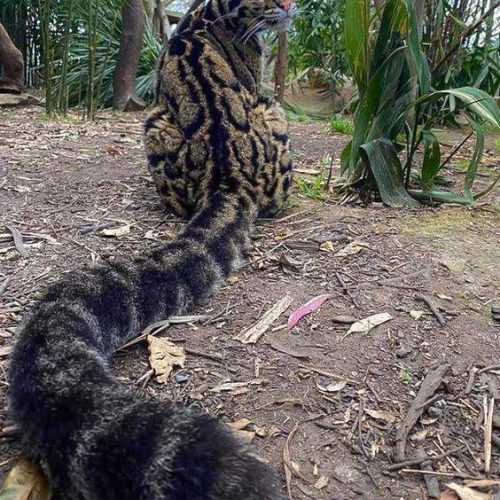
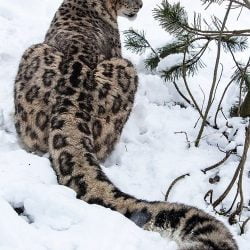
Where Do Clouded Leopards Live? The clouded Leopard is about the size of a small leopard but, in my opinion, it’s tail relative to its overall size is perhaps the longest of all the felids except for perhaps the snow leopard’s (see below). Fiona Sunquist in her book Wild Cats of the World modestly …
The question is inherently incorrect! Evolution dictates the length of cats’ tails and evolution is always correct in the very long-term. Tails are functional and they have to be at a certain length in order to carry out the function for which they are designed. The function of the tail is to help provide …
A cat’s tail is all three of the above. It is made up of bone, muscle, blood vessels and nerves just like the other parts of a domestic cat’s body. It is no more or less sensitive than the other main areas of the cat’s body in my view. But clearly it should not …
A cat’s tail is made of bone (caudal vertebrae), ligaments, tendons, cartilage, muscle, skin and hair. A typical cat has between twenty-one and twenty-three caudal vertebrae which are extension of the spine. Exceptionally a cat with a full tail may have as few as eighteen or as many as twenty-eight of these bones. They …
The average length of the domestic cat’s tail is 10 inches or 25 centimetres. It is essential to specify the cat species because they vary enormously in length depending on the species. I am assuming that the question relates to domestic cats. I think that you’ll find some variations to the answer on the …
Note: Some older videos on this page were hosted on Vimeo. That account has now been retired, so a few video blocks may appear blank. Thanks for understanding — there’s still plenty of cat content to enjoy!