The origin of the domestic cat ‘tail-up’ body language greeting is interesting and important as it highlights a central element in the human-to-cat relationship, namely that cat caregivers are perpetual mothers to their adult cats which serves to indoctrinate the adult cat into maintaining kitten behaviors one of which is the tail up greeting; …
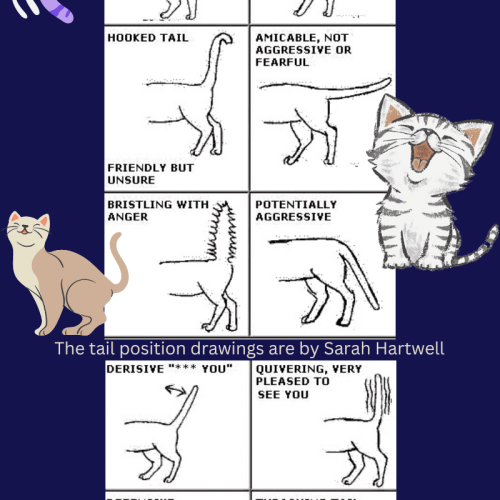
Essentially, domestic cats use their tail as a means of communication and its position conveys their emotions and intentions. A domestic cat holds their tail vertically – called the “tail-up” position – when greeting a friendly cat. They’ll do the same when greeting their owner. It’s a sign of relaxed confidence in the encounter. …
I hope this two pages of an infographic helps in understanding domestic cat tail body language/signalling. It can be quite subtle. There is one cat breed, a rare one, with a curled-over tail called the American Ringtail. This cat will struggle with one or two of these tail signalling positions! And, of course, the …
A study described the use of space and patterns of interaction among a group of 14 unrelated domestic cats living in a single-story house. Although I am referring to a scientific study, cat owners should not be put off by that because the findings are interesting. Cats are very intelligent in finding ways to …
Introduction: This article on the social function of tail up in domestic cats is based a scientific research paper of very similar title prepared by S.Cafazzo and E.Natoli. and which was published on the internet by Science Direct. The right to read the entire document was purchased by me. It is a summarized version …
Why do domestic cats carry out ‘scent exchange’ with their owner? First of all, what is scent exchange? It may not be apparent to a cat caregiver that it is taking place. However, it happens very often, particularly when a cat owner comes home and their cat greets them. The cat will do one …
I am discussing the domestic cat’s tail. Having thought about this for the first time, I’ve decided that the positioning and movement of a cat’s tail is between a voluntary and an involuntary action. Therefore, it does not quite have a mind of its own but neither does the cat have direct control over …
In general, feral cats do not meow. This is because it is usually a learned vocalisation between domestic cat and human caregiver which is employed to ask for something. We hear it a lot. In short, it a product of cat domestication. However, I would expect that the meow must have entered the feral …
Note: Some older videos on this page were hosted on Vimeo. That account has now been retired, so a few video blocks may appear blank. Thanks for understanding — there’s still plenty of cat content to enjoy!