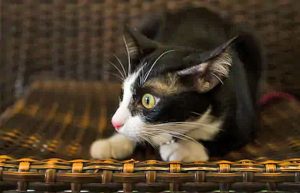
This is a topic that interests me: how artists of the mediaeval era depicted domestic cats in their paintings. And I’m sure that they felt that they were painting an accurate representation of the domestic cat before them. But by today’s standards they are quite poor for one reason: they humanised them. They painted …
It is sad and telling of modern life that the famous place where the first wildcats were domesticated by farmers, the Fertile Crescent, which encompasses Syria and the Euphrates and Tigris rivers, is now a place where there are no farmers tilling the fields because the river, which was once swollen with floodwaters, has …
It seems that “scaredy-cat” first appeared in print as “fraidie-cat” (fraidy-cat). The two sayings having very similar meanings. And they’re both based on the fact that domestic cats are often frightened of strangers. A person is described as a scaredy-cat if they are unwilling to try something new. You can see the similarity. Something …
Yes, there is a common ancestor to the cat and dog. If you believe in evolution as set out by Charles Darwin in his work “On the Origin of Species by Means of Natural Selection…” you will believe that there is a common ancestor to all animals not just cats and dogs. And that …
The photograph is described as ‘Tinder 1913’. There are four guys in the snow outside a log cabin. Two of the men are holding cats, one has a dog and the fourth does not have an animal companion. The sign is clear: they want wives. The companion animals are a substitute for wives. That’s …
The question is about the etymology of the word ‘lion’. My research informs me that the word is derived from the Latin ‘leo’ and Ancient Greek ‘leon’. Leon is also a first name for people of Greek origin since ancient times. Leon appears to have preceded the Latin ‘leo’. It seems to me that …
The public should know that the genius Mozart liked to imitate domestic cats when he was bored. And it appears that he was bored quite a lot because he was so intelligent. I think intelligence begets boredom. That fact that he expressed his boredom by imitating cats indicates that he was very aware of …
Jeoffry was the pet cat of the tragic 18th-century poet Christopher Smart (11 April 1722 – 21 May 1771) during his time in a mental asylum, otherwise described as bedlam. While in a mental asylum he was alone except for his cat and the occasional gawker. Therefore, his cat kept him company and he …
Note: Some older videos on this page were hosted on Vimeo. That account has now been retired, so a few video blocks may appear blank. Thanks for understanding — there’s still plenty of cat content to enjoy!