I’ve just bumped into another reason why a domestic cat might attack their own tail. We see a lot of this but it is normally in play. It’s just chasing their tail but if they end up biting their tail hard and even, God forbid, going further and biting off the tip of their …
A cat’s tail is made of bone (caudal vertebrae), ligaments, tendons, cartilage, muscle, skin and hair. A typical cat has between twenty-one and twenty-three caudal vertebrae which are extension of the spine. Exceptionally a cat with a full tail may have as few as eighteen or as many as twenty-eight of these bones. They …
There are a few reasons why domestic cats have better balance than people although there is an overlap in the anatomy of cats and people with respect to balance. Vestibular apparatus Both humans and cats have a vestibular apparatus. It is in the inner ear. It is made up of three fluid-filled semicircular canals. …
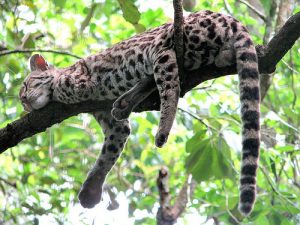
A cat’s tail serves two main functions (1) to assist in balance particularly at times when balance is critical such as climbing trees to hunt and (2) a signal in feline body language when it takes up various positions such as ‘tail up‘ which signals a friendly approach. The small wild cat the margay …
Don Sutherland, 22, shared the footage of his cat companion, Aslan, sauntering around their house in Calgary, Alberta, Canada. As you can see his poor cat has had part of his tail amputated and in order to achieve that the surgeon has removed the fur on the tail and from the surrounding area – …
The average length of the domestic cat’s tail is 10 inches or 25 centimetres. It is essential to specify the cat species because they vary enormously in length depending on the species. I am assuming that the question relates to domestic cats. I think that you’ll find some variations to the answer on the …
The San Antonio Express-News has a letter from a visitor which discusses a kitten living in Houston with her owner who had an extremely small stub of a tail. The kitten had trouble controlling her urinary flow. The kitten was seen by a veterinarian who she said that cats with vestigial tails have bladder …
In a previous post, some time ago, I explained why snow leopards have very long tails and this answer is along similar lines. Mel and Fiona Sunquist in their book Wild Cats Of The World describe the leopard’s tail as: “The long, thin tail is about 60 to 75 percent of the head and …
Note: Some older videos on this page were hosted on Vimeo. That account has now been retired, so a few video blocks may appear blank. Thanks for understanding — there’s still plenty of cat content to enjoy!