When you watch the domestic cat eating food you might think that they use their incisor teeth to grab food and then push it back to their premolars to masticate it into a form where it can be swallowed. But you would be mistaken. The domestic cat’s wild cat ancestor evolved dentition which is …
It is more difficult to work out a domestic cat’s age from appearance than it is to do the same thing with humans. Normally, most people can work out a human’s age from appearance to within 5-10 years, which as a percentage of their lifespan is about 10%. To hit that target for cats …
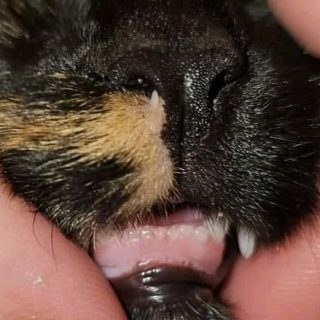
To almost everyone except veterinarians, this is a very unusual cat photograph. It shows the closed mouth and the nose of a tortoiseshell cat with a tooth protruding from the upper jaw into the opening of the right nostril. And if you look to the right of the picture there appears to be two …
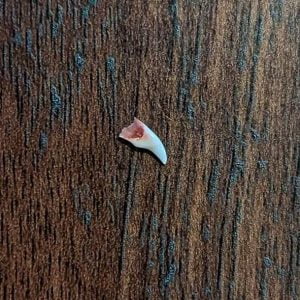
A cat owner on the Reddit.com website (user u/maifoothurts) asked whether young cats lose their baby teeth. The question was accompanied by a pretty stark photograph which you can see below of a canine tooth which had snapped off and come to rest on the living room floor. The answer is yes. See the …
Do cat’s teeth fall out? The answer is yes for baby teeth but no for adult teeth. If an adult cat’s teeth are falling out see a veterinarian asap. There will be severe gum disease I expect. Rarely an adult tooth or teeth can be lost during a fight or because of trauma. It …
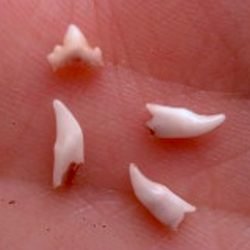
A newborn kitten normally has no teeth but yes, cats have baby teeth which begin to erupt when kittens are about 21 days old. They are fully in place by 5-6 weeks of age. The 30 permanent teeth erupt when kittens are 4 months of age. They are complete at around 7 months of …
Do cats have more teeth than dogs? No, is the answer. It’s the opposite. Because cats have a shortened face they also have shortened jaws with less space for teeth. Cats have fewer teeth than other carnivores in fact; normally 28 or 30 compared with 42 for dogs and bears.
Very rarely kittens are born with teeth. Usually they are born without teeth. The incisors are the first deciduous (baby) teeth to appear, usually at 2 to 3 weeks of age. Canine teeth emerge at 3 to 4 weeks of age and the premolars at four to six weeks. The last premolar emerges at …
Note: Some older videos on this page were hosted on Vimeo. That account has now been retired, so a few video blocks may appear blank. Thanks for understanding — there’s still plenty of cat content to enjoy!