People ask the question: “Why are domestic cats and invasive species?” And the answer is that in most countries of the world domestic cats did not evolve in those countries but they were brought there by people. It is only when an animal either evolves in a certain place or its distribution extends to …
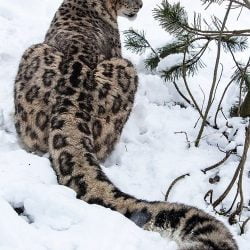
The question is inherently incorrect! Evolution dictates the length of cats’ tails and evolution is always correct in the very long-term. Tails are functional and they have to be at a certain length in order to carry out the function for which they are designed. The function of the tail is to help provide …
I’ve recently been doing research on whether owning a caracal is illegal in Australia (I shouldn’t have bothered). It was very hard research because the documentation provided by Australian administrations was poor. What I found was a continual reference to “pests” and “invasive species” or “alien species” or “non-native species”. To Australians non-native species …
Although some people might believe it, it’s not true that cats do not have facial expressions. I would like to get that out of the way initially. Cats do show their mood but it is very subtle and most often it concerns feeling pain. The face becomes tighter and it subtly changes shape. Therefore, …
Eighty-five million years ago, Australia, New Guinea, and New Zealand separated from the major land mass called Gondwanaland. About 200 million years ago Australia was attached to Antarctica. 85 million years ago was well before the beginnings of the evolution of the cat. It is believed that around 60 million years ago there were …
Researchers have decided that cats evolved from a fierce saber-toothed predator that occupied North America 42 million years ago. They also decided that this “new species” was among one of the first mammals to be an obligate carnivore. At this time, I don’t have the full report of the study. And therefore, I don’t …
This post is specifically about the evolution of the domestic cat since domestication. I do not address the evolution of the wildcat pre-domestication. It’s fairly well-known and currently accepted that the first domestic cats on the planet existed around 10,000 years ago. We don’t know exactly when. It may be earlier than that perhaps …
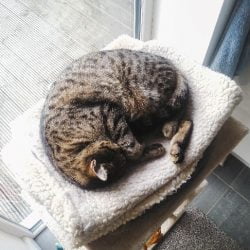
Domestic cats don’t always curl up when they sleep but they often do. It’s the default position. Although, we do see some extraordinary sleeping styles for the domestic cat; being totally stretched out is also not uncommon inside the home. But being curled up and stretched out are linked. I’ll explain what I mean. …
Note: Some older videos on this page were hosted on Vimeo. That account has now been retired, so a few video blocks may appear blank. Thanks for understanding — there’s still plenty of cat content to enjoy!