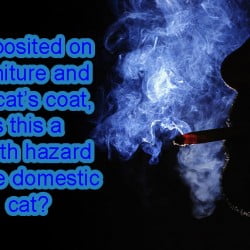
Most smokers (78%) know that their habit could harm their cats. Both this finding and the one in the title are disturbing because they mean that cat owners who smoke are willing to harm their cat for the sake of maintaining their habit. The pet insurer MORE TH>N carried out a survey on smokers …
This is an interesting but bafflingly complicated study about measuring facial expressions in non-human animals. I’ll summarise it in my own way but if you are interested you should read the full report on Nature.com (see link at base of page). It should be of interest to concerned cat guardians as it helps to …
For donkey’s years the world has been under the misapprehension that there is a female of the human species who is obsessed with domestic cats, who keeps far too many of them, who is solitary, anxious and depressed, and has no friends. This is the so called ‘crazy cat lady’ and they don’t really …
A study published on June 12, 2019 shows that when undergraduates participated in 10 minutes of hands-on interaction with cats and dogs from a local shelter their stress levels were reduced as measured by saliva cortisol levels after the test. University students report high levels of stress and the problem is apparently getting worse. …
This article provides insights into cat breed social and non-social behaviour based on a questionnaire survey of the owners of over 5,000 purebred cats.
“The loss of such a sacred relationship can be devastating. Owners of companion animals facing the loss of a companion animal often experience numbness, disbelief, ruminations about the death experience….” Working as an animal care worker (ACW), specifically an animal shelter worker, leads to close bonds with the animals in their care. The conditions …
There’s a 5,500 km dingo fence between Queensland and Western Australia. On one side dingoes have been culled to the point where they hardly exist in order to protect livestock. On the other side dingoes live as they live elsewhere in Australia. The fence has created two ecosystems, one on each side of it. …
Domestic cats can tell the difference between different sounds and if one of those sounds is the sound of their name the domestic cat will distinguish it from other sounds thereby recognising her name. This a major finding in a Japanese study: Domestic cats (Felis catus) discriminate their names from other words. I don’t …
Note: Some older videos on this page were hosted on Vimeo. That account has now been retired, so a few video blocks may appear blank. Thanks for understanding — there’s still plenty of cat content to enjoy!