On the internet, people ask if sand cats can be tamed and therefore be a pet. I can see why because this small wild cat species is attractive and not dissimilar to a domestic cat in appearance. There are two points to cover. Firstly, sand cats should not be forced into being an exotic …
I think I’d better start this discussion by clarifying what a ‘cat species’ is. There are around 37 cat species. The number depends on how you classify them (taxonomy) and there is still some discussion on that topic. All bar one are wild cats. One of the species or subspecies is the domestic cat …
If you are up to scratch on your wild cat species, you might have heard of this trio. Two are small, about the size of a domestic cat, while the third is medium-sized. The video comes from San Diego Zoo. The lady who provides the voice-over has, I think, made quite a nice selection …
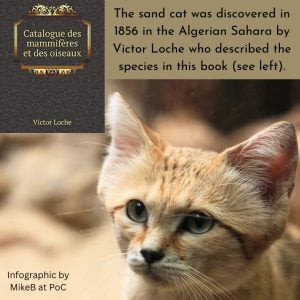
The sand cat was discovered in 1856 by Captain Victor Loche at Ngouca in the sand dunes of eastern Algeria near the Libyan border. He was on an 1856-1857 French expedition to the Algerian section of the Sahara. He was listing and describing the mammals and birds of the area for the book Catalogue …
A study has come to the astonishing conclusion that the diminutive sand cat, about the size of a small domestic cat at 7.5 pounds, has an enormous home range in Morocco. Or, perhaps, it doesn’t have a home range at all and is nomadic. Either way the revelation is extraordinary. In Morocco female sand …
Simple: sand cats get sufficient water from their prey animals to survive without drinking free-standing water for most of the year. We should remind ourselves that the prey of the sand cat is made up of between 70%-80% water. Humans are about 60% water. A couple of researchers: WG Heptner and AA Sludskii in …
This page has been updated on May 15, 2022. You need to do this with articles about the distribution of any animal because it changes. Below this section there is information about the distribution of the sand cat as at 2009. I have retained it as an archive and because it’s interesting to compare. …
The origin of the scientific name of the sand cat is interesting. This cat species was discovered by Capt. Victor Loche in 1856 in eastern Algeria on a French expedition lead by General Margueritte. He named the cat Felis margarita after the expedition leader. Although at one time it was thought that this cat …
Note: Some older videos on this page were hosted on Vimeo. That account has now been retired, so a few video blocks may appear blank. Thanks for understanding — there’s still plenty of cat content to enjoy!