I think this story very much lends itself to an infographic as the technique described for attempting to restore the hybridized Scottish wildcat to its pure former pure self is essentially straightforward although technically it is a very tricky process that might not work satisfactorily. In order to be a success, it has to …
RELATED: Information about the hybridisation of the Scottish wildcat There was a story on the Internet that the last wildcat in England was shot in 1835. I repeated it on this website. But the information seems very doubtful. There appears to be no hard evidence of it. I have conducted quite a thorough search …
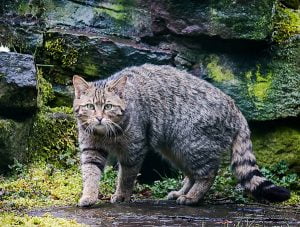
This is a really good photograph of a European wildcat taken Lucia Ursu in the Parcul Național Retezat National Park. It is special because this is the true appearance of the European wildcat and on a linked topic the Scottish wildcat is a European wildcat. You can see the difference between the Scottish and …
To answer the question, you have to break it down into categories which I’ve done. There’s a difference between the behaviour of the wildcat ancestor which is the same species as the domestic cat and from which we can learn about domestic cat behaviour, unsterilised male cats, sterilised male cats and kittens parented by …
A study has concluded that the brains of domestic cats have shrunk during the time that they have been domesticated. And having shrunk I have concluded that domestic cats are probably more stupid today than they were at the time of the Ancient Egyptians. And I suspect that they will go on becoming a …
The European Wildcat is, like other Wild cat species, under continual pressure from human population growth and activity. The wildcat is the ancestor of the domestic cat and therefore they are arguably the ‘authors of their own demise’ in that they mate with outside, unsterilised domestic cats resulting in the gradual hybridisation of the …
Take a domestic tabby cat, make them a little larger, make them more substantial with a thick and slightly longer and denser coat, make the tabby markings a little less pronounced and give the cat that classic, unneutered jowly appearance and you’ve got yourself a European wildcat. The same kind of description applies to …
The question is a sensible one because all of the world’s half a billion domestic and feral cats originate in a domesticated North African wildcat (Far Eastern wildcat or African-Asian wildcat). It happened about 10,000 years ago. Nowadays there are still wild cats roaming around Europe. These are European wildcats which Ire still found …
Note: Some older videos on this page were hosted on Vimeo. That account has now been retired, so a few video blocks may appear blank. Thanks for understanding — there’s still plenty of cat content to enjoy!