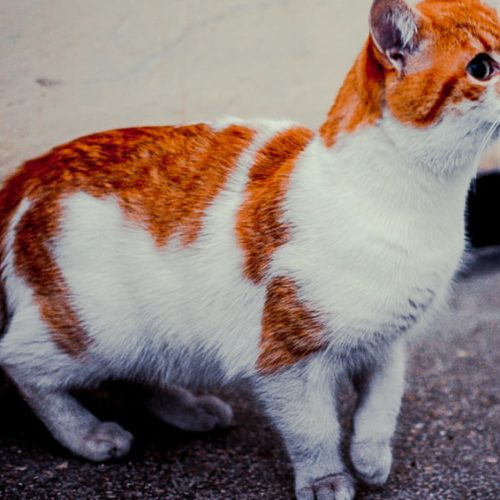
The infographic by me summarises information about bicolour cats. I hope you find it useful. There are image links to more pages on piebaldism and bicolour cats after the infographic.
Note: I am indebted to Sarah Hartwell of messybeast.com for her knowledge on piebaldism and the images in the middle of the infographic about grading. Other source: me and Gloria Stephens of Legacy of the Cat.
In the cat world ‘harlequin’ is a word that is occasionally (but rarely today) used to describe the bi-colour coat with more white fur than non-white fur. Bicoloured cats are white plus distinct areas of colour. For the harlequin, the coat should be 50-75 per cent white and 50-25 per cent coloured. This coat …
Richard Kitty is one of the most popular Instagram cats. What is really nice about Richard is that he is a former shelter cat. He was rescued from a Los Angeles, California, USA, public shelter in 2012 when he was two-years-of-age, which makes him around 12-years-of-age as at the date of this post. His …
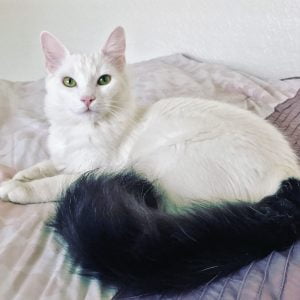
Yes, the title is complicated. Deliberately so to catch the eye as does the cat who was adopted as a feral kitten. She grew up to be a genuine beauty: totally white except for a black plumed tail, all on a silky medium-longhair coat. I guess the woman who adopted her saw the beauty …
I am unsure if this is a genuine cat. It looks like it because the black spots are made of fur which is slightly longer than the white fur. It is as if it is embossed onto the body. I have seen this before with Bengal cats when the dark markings are raised above …
You’ve probably never seen a domestic cat coat like this before. The coat is bicolour meaning two colours: white and dark brown in this instance. The coats are sometimes referred to as ‘solid-and-white’. This coat is very strange because of the dark stripe running down the length of the spine. The markings on the …
The total amount of melanin (pigment) in the iris of the eye determines the range of eye colours in cats and in humans. The same principles apply to all animals with a similar eye anatomy. The pigment ‘melanin’ is produced by cells called melanocytes. The amount of pigment produced and the way that melanocytes …
The question effectively asks why cats are white all over. It is because they have a dominant gene symbolised by the letter W which removes pigment from the hair strands. It does this by removing the pigment creating cells in the skin. These are called melanocytes. Genes are on chromosomes and chromosomes are in …
Note: Some older videos on this page were hosted on Vimeo. That account has now been retired, so a few video blocks may appear blank. Thanks for understanding — there’s still plenty of cat content to enjoy!