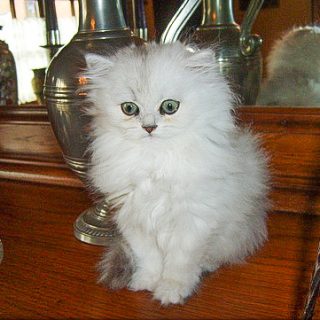
The word ‘chinchilla’ is used a lot in the cat fancy and it is associated with Persian cats. Usually not the extreme bred, flat-faced variety but the traditional doll-faced types. But there appears to be a certain flexibility in the meaning and use of the word which I have illustrated in the infographic. In essence ‘chinchilla’ refers to a type of coat in the cat world, specifically the cat fancy. The name has been taken from the name of a South American rodent with the same coat.
The infographic by me summarises information about bicolour cats. I hope you find it useful. There are image links to more pages on piebaldism and bicolour cats after the infographic.
Note: I am indebted to Sarah Hartwell of messybeast.com for her knowledge on piebaldism and the images in the middle of the infographic about grading. Other source: me and Gloria Stephens of Legacy of the Cat.
This is an infographic which summarises albinism in cats. Rarely you will see albino wild and domestic cats. You will see quite a lot of people confusing cats that are completely white with blue eyes or odd-eye colour caused by the dominant white gene and albino cats with light-blue to pink eyes. The eyes are a good way to tell the difference. There are more articles with a reference to albinism below the infographic
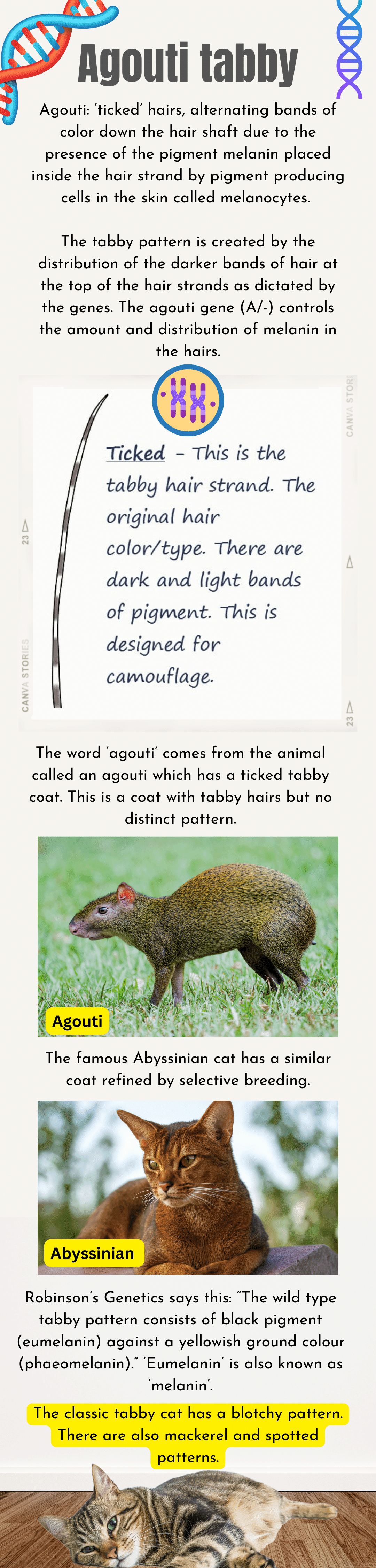
This is my infographic on the agouti tabby domestic cat coat which we all know. It is the original cat coat.
We all know that the domestic cat tabby pattern is the most common and best known as it comes from the domestic cat’s wildcat ancestor the North African wildcat which has a less contrasty spotted/mackerel tabby coat. Domestication introduced the blotched tabby in the 19th century; a late arrival.
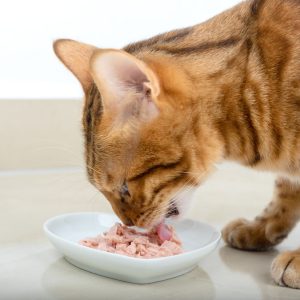
Domestic cats have the required ‘umami’ taste receptors on their tongues to respond well to an enzyme called inosine monophosphate and an amino acid called free L-Histidine which combine to produce a strong umami taste. Cats enjoy these taste receptors thanks to the inheritance of Tas1r1-Tas1r3 genes. The umami taste is described as the …
As per the Cat Fanciers’ Association (CFA) breed standard the eye colour of the Siamese cat is always a “deep vivid blue” and that eye colour is the same across all the different Siamese cat colours from seal point through to chocolate point, blue point and lilac point. And it is the same across …
We can see that this is a leopard and not a jaguar as the leopard is slenderer than the stockier jaguar. They melanistic jaguars look amazing. I don’t know where it was taken. It could be one of many countries as the common leopard has the widest distribution of all the wild cat species. …
Note: Some older videos on this page were hosted on Vimeo. That account has now been retired, so a few video blocks may appear blank. Thanks for understanding — there’s still plenty of cat content to enjoy!